Cheese and Blood Sugar — Why Most Cheeses Are Near-Zero on the Curve, and Which Ones Aren't
Cheese and Blood Sugar — Why Most Cheeses Are Near-Zero on the Curve, and Which Ones Aren’t
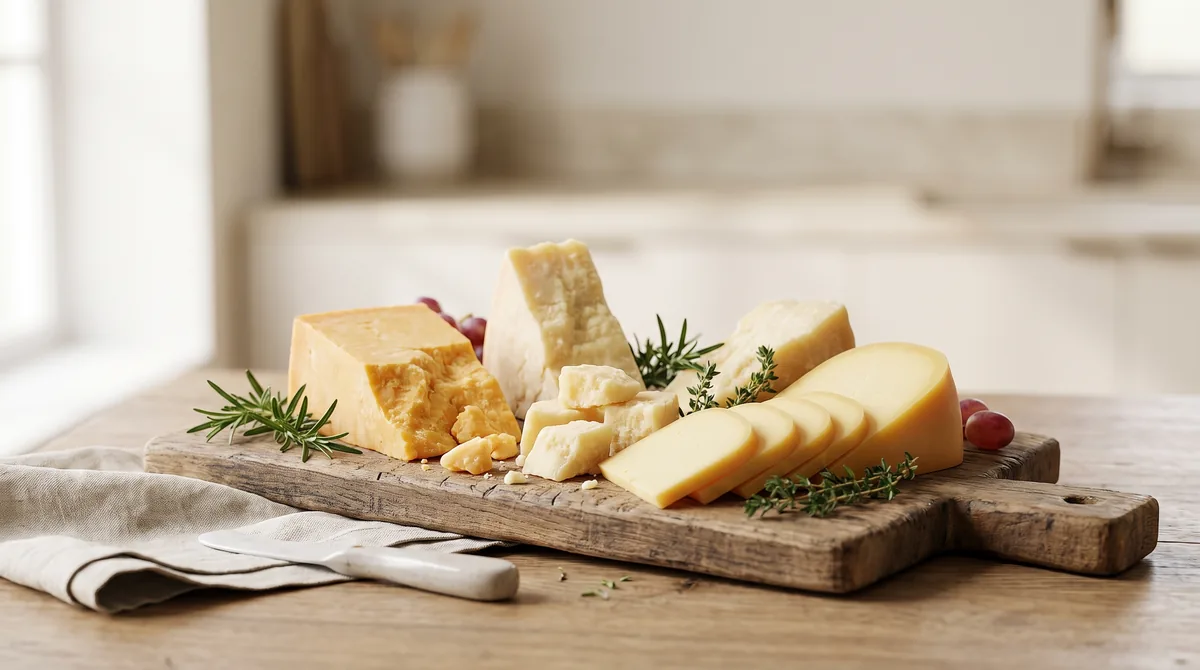
If you have insulin resistance and you like cheese, most of the news is good. The aged, hard, and semi-hard cheeses that dominate a cheese board — cheddar, parmesan, gouda, gruyère, manchego — contain almost no carbohydrate, and their combination of fat and protein makes them one of the flatter foods you can eat on a glucose monitor. Cheese is one of the few genuinely low-glycemic indulgences that doesn’t come with a mechanism-hidden trap.
But cheese is not one food. It is a broad category covering everything from a nearly-carb-free block of parmesan to a scoop of sweetened ricotta to a slice of processed American cheese sitting on top of a hamburger bun. The story splits along two lines: what kind of cheese you’re eating, and what it is eaten with. This piece walks through the main cheese categories, what each does to blood sugar, and where the practical traps are.
The mechanism — why aged cheese is metabolically quiet
Fresh milk contains about 4–5% lactose, the milk sugar that pushes blood glucose up modestly when you drink a glass of milk. During cheesemaking, most of that lactose leaves with the whey when the curds are separated. What remains in the curd is then fermented by bacteria, which consume lactose and convert it to lactic acid. The longer a cheese ages, the less residual lactose remains, and the ratio of fat and protein to carbohydrate becomes overwhelming.
By the time a cheese is aged more than a few months, the lactose content is essentially zero — this is why many people with lactose intolerance can eat aged cheddar or parmesan without issue but not drink milk. The remaining nutrients are protein (casein, which digests slowly and blunts glucose responses) and fat (which slows gastric emptying and further flattens the curve).
Result: a 30 g portion of hard cheese, on its own, produces a glucose response that is barely visible on a monitor. There is not enough carbohydrate present for the body to spike. Cheese’s blood-sugar risk lies not in the cheese itself, but in what it is served alongside — a slice of bread, a cracker, a bun, a bowl of pasta — because cheese is often the vector for high-carb foods to reach your mouth in a form that tastes good enough to overeat.
Aged hard cheeses — cheddar, parmesan, gouda, gruyère, manchego
These are the flattest cheeses on a curve. A 30 g portion of aged cheddar contains roughly 0–1 gram of carbohydrate, 8 grams of protein, and 10 grams of fat. Parmesan, aged even longer, is essentially carb-free — under half a gram per 30 g. Gouda and gruyère sit in the same neighborhood.
For someone managing insulin resistance or type 2 diabetes, these cheeses are functionally free. You could eat a 60 g slice as a snack and not see a meaningful glucose response. The main constraint is calorie load, not glucose — hard cheeses are dense (~120 kcal per 30 g), and portions add up quickly. But on the metabolic axis this piece is about, they are close to inert.
Practical use: a piece of aged hard cheese with a handful of nuts or olives is one of the best low-glycemic snacks available — high satiety, near-zero glucose effect, and forgiving on portion size within reason.
Semi-hard and semi-soft cheeses — mozzarella, feta, halloumi, provolone
Semi-hard cheeses sit slightly higher in carbohydrate than aged hard cheeses — about 1–3 grams of carb per 30 g portion, depending on age and moisture. Mozzarella (especially fresh, water-packed mozzarella) is on the higher end because it retains more moisture and slightly more residual lactose. Feta and halloumi are similar. Provolone and edam are drier and closer to the hard-cheese range.
Even at the top of this band, the numbers are small enough that a normal portion has a negligible glucose effect. A caprese salad with 60 g of fresh mozzarella, some tomato, and olive oil is a low-glycemic meal by any reasonable definition. Grilled halloumi with vegetables sits in the same category.
The practical distinction is that fresh, wet cheeses spoil faster and are eaten in larger portions — a snack of a 100 g ball of fresh mozzarella will contribute a few grams of carbs, still low but not zero. Worth knowing if you’re stacking foods carefully.
Fresh cheeses — cottage cheese, ricotta, cream cheese, quark
Fresh cheeses are the category with the widest range, because they still contain meaningful amounts of whey and therefore lactose. This does not make them bad for blood sugar — most are still low-glycemic — but the story is more nuanced than “cheese is fine”.
Cottage cheese is the standout. A cup of unflavored cottage cheese contains about 6 grams of carbohydrate (mostly lactose), 25 grams of protein, and modest fat. The high protein-to-carb ratio produces one of the flattest glucose curves you can get from a substantial meal-sized portion. It is one of the highest-quality foods available for insulin resistance, and we cover the specifics in a companion piece on cottage cheese specifically.
Ricotta is close to cottage cheese in profile but slightly higher in carbohydrate and lower in protein — a similar story with a somewhat gentler protein blunting. Fine as a component of a meal; watch the portion if it’s the main event.
Cream cheese is the outlier: high fat, very low carbohydrate (~1 gram per 30 g portion), very low protein. It is not a protein source, but it is metabolically quiet on its own. The trap is that cream cheese is almost always eaten on bread — bagels being the archetypal example — and the bread is what drives the response, not the cream cheese.
Quark, popular in central and eastern Europe, is similar to a drained cottage cheese: about 4 grams of carb per 100 g, high protein, moderate fat. Same rules as cottage cheese apply — it’s an excellent choice for insulin resistance.
Flavored variants of any of these fresh cheeses — strawberry cream cheese, vanilla cottage cheese, honey ricotta — change the calculation entirely. Added sugar is common and can push the carbohydrate content up several-fold. Read the label; the unflavored versions are always the safer default.
Processed cheeses — American slices, spray cheese, cheese sauce
Processed cheese products are made by melting and blending natural cheeses with milk proteins, emulsifiers, and often added starch, water, and flavorings. The metabolic profile depends on how much actual cheese is present and how much filler.
A typical slice of American processed cheese contains about 2 grams of carbohydrate, which is not much on its own. But the texture and taste are engineered for hamburger buns, grilled cheese sandwiches, and cheese fries — high-carb vehicles that the “cheese” makes appetizing. The blood-sugar impact of any of those meals is dominated by the bread or potatoes, not the processed slice.
Cheese sauces — the ones on nachos, in mac-and-cheese boxes, on cheese-covered fries — often contain added starch or flour, pushing the carbohydrate content higher. And again, the base food (chips, pasta, potato) is doing most of the glucose work.
Practical read: processed cheeses are neither villain nor hero on their own. They become a problem exclusively through what they carry into your meal. If you’re eating cheese for the cheese, aged natural cheeses are a nicer product and a cleaner metabolic story. If you’re eating cheese on top of something else, the something else is what to think about.
The bread-and-cheese trap
The largest practical problem with cheese and blood sugar is not any specific cheese — it is the fact that cheese makes high-carb foods more edible in large quantities. A slice of bread on its own is a modest treat. A slice of bread with butter and cheddar is a genuinely pleasant food that most people can and will eat several of. The same pattern holds for crackers with cheese, pizza (the cheese is the reason you eat more slices), and creamy pasta sauces.
The mechanism-first way to think about this is that cheese is a delivery vehicle. When you plan a meal around cheese, the cheese itself is glycemically quiet — but if the vehicle is bread, crackers, or pasta, the glucose response follows the vehicle, and the cheese has effectively enabled a larger dose of it.
Two practical patterns work well:
- If you want the flavor of cheese as the main event, build the meal around vegetables, cured meats, olives, and nuts. Cheese is happy in that company and the glycemic total stays low.
- If you want cheese with a starch, keep the starch portion small and eat the cheese and other fats first — the fat delays glucose absorption from the starch that follows, so a small piece of bread eaten after a slice of cheese produces a smaller spike than the same bread eaten alone.
Cheese and portion control
A subtler practical issue is that cheese is calorically dense — 100–130 kcal per 30 g for most hard cheeses, higher for very fatty ones — and easy to eat in large amounts. On a monitor, this doesn’t produce spikes; on a scale over months, it can. For insulin resistance, weight loss often reduces insulin resistance itself, and calorie load matters even when glucose response doesn’t.
This is not a reason to avoid cheese. It is a reason to treat “cheese is metabolically free” as a statement about glucose only, not about all metabolic factors. Portion the cheese by weight, not by “a few pieces”, and keep an eye on the total daily amount if weight is on your list of priorities.
The bigger picture — cheese is one of the easier wins for IR
Compared to almost every other food category in the “does this spike my blood sugar” conversation, cheese offers an unusually simple answer for most of its members. Aged hard cheeses are functionally carb-free. Semi-hard cheeses are near-zero. Fresh cheeses have low-to-modest carb content and high protein. Only flavored fresh cheeses and processed cheese sauces sneak in enough added sugar or starch to become glucose events on their own.
The complications live not in the cheese but around it: what you eat cheese with, how much of it you eat in absolute terms, and whether the “cheese” in your meal is doing the glycemic work or hiding behind a bun or a cracker. If you build meals that treat cheese as a genuine main-event food, with vegetables and other low-carb companions, it becomes one of the most forgiving foods on the menu for someone managing insulin resistance.
There is no need to overthink this one. Buy the cheese you actually like, eat portions you’d recognize as portions, and let the carbohydrate discipline live in the parts of the meal where it is actually needed.
If you want a personal, food-by-food picture of how cheeses fit into your own routine — including which pairings make sense on your particular pattern of readings — Logi analyzes what you eat and answers directly whether it fits your goals, using continuous glucose data if you have it and a hunger/energy log if you don’t.
This article is general nutrition education, not medical advice. If you have diabetes, take insulin or sulfonylureas, or have any medical condition that affects how your body handles food, discuss changes to your diet with your doctor or a registered dietitian.
Take control of your blood sugar
Scan your meals, track glycemic load, and see your patterns — all in one app.
मुफ्त ट्रायल शुरू करें →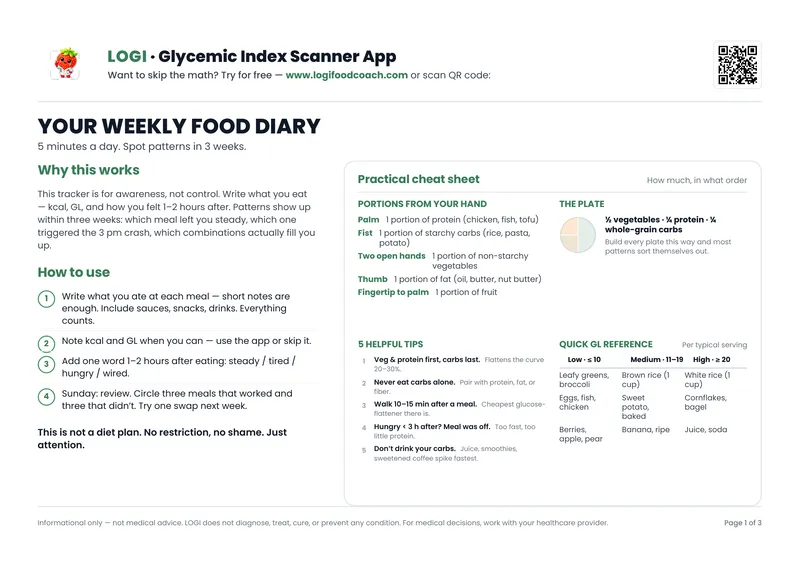
मुफ़्त PDF — 3 पेज
साप्ताहिक फ़ूड जर्नल
भोजन, ग्लाइसेमिक लोड और मूड ट्रैक करें। 3 हफ़्तों में पैटर्न पहचानें।
कोई स्पैम नहीं। कभी भी सदस्यता रद्द करें।