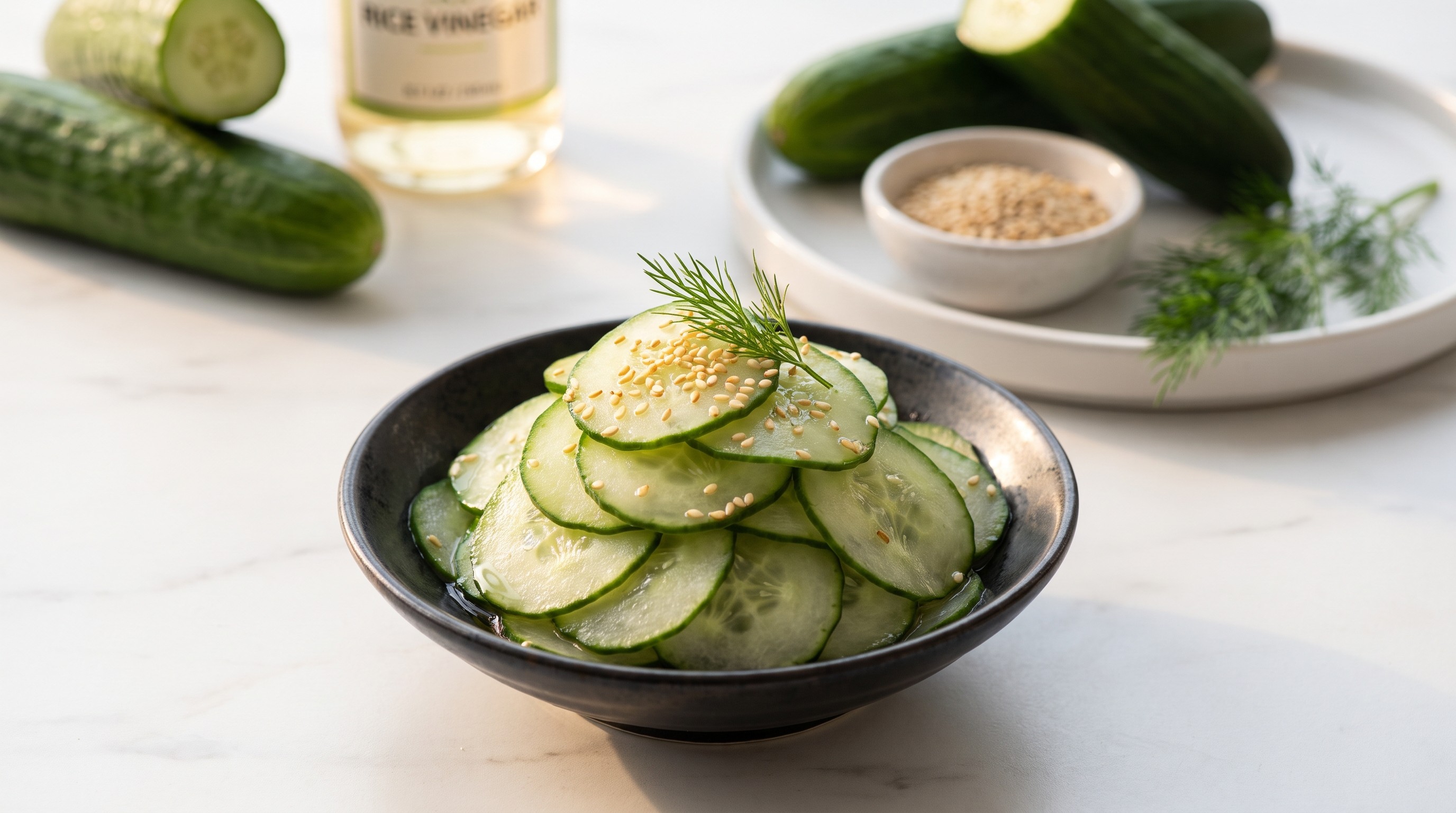
Sunomono (Japanese Cucumber Salad)
Crisp, paper-thin cucumbers in a tangy rice-vinegar dressing with sesame — a virtually zero-carb Japanese side that supports steady blood sugar.
Sunomono is one of Japan's most elegant small dishes: translucent rounds of cucumber, briefly wilted with salt, then bathed in a bright rice-vinegar dressing sharpened with soy and softened by a bare touch of sesame oil. With almost no digestible carbohydrate per serving, it is low-glycemic by nature rather than by substitution, making it an ideal opener or side for anyone managing blood sugar.
The star of this recipe isn't just the cucumber — it's the vinegar. A growing body of research suggests that acetic acid, the main component of rice vinegar, can slow gastric emptying and blunt the post-meal glucose spike when consumed alongside higher-carbohydrate foods. Starting your meal with sunomono before moving on to rice or noodles is a traditional Japanese habit that happens to align with modern glycemic science. The single teaspoon of sugar in the dressing dissolves across two servings, contributing roughly two grams of sugar per bowl — a negligible glycemic load.
Preparation takes barely fifteen minutes and requires no cooking at all. The brief salting step is essential: it draws out water, collapses the cell walls, and allows the cucumber to absorb the tangy dressing rather than dilute it. Squeeze the slices firmly — the drier they go in, the more flavour they soak up. Serve sunomono chilled alongside grilled fish, tofu, or any protein-rich main for a blood-sugar-friendly meal structure that follows the 'vegetables first' principle recommended by glycemic researchers.
Blood Sugar Impact
Very low blood sugar impact expected. The combination of cucumber (very low GI), vinegar (which actively blunts glucose response), and healthy fats from sesame oil results in a GL of only 3.3, meaning blood sugar should remain virtually stable.
Blood Sugar Tips
- ✓ The rice vinegar in this dish already works in your favor — acetic acid slows gastric emptying and improves insulin sensitivity, so enjoy the dressing generously.
- ✓ Reduce or substitute the added sugar with a pinch of erythritol or simply use less to further lower the already minimal glycemic load.
- ✓ Pair this salad as a starter before a higher-carb main course — the vinegar and fiber will help blunt the glucose spike from whatever follows.
🥗 Ingredients
- 1 pcs English cucumber
- 0.5 tsp Fine salt
- 2 tbsp Rice vinegar
- 2 tsp Soy sauce
- 1 tsp Sugar
- 1 tsp Toasted sesame oil
- 1 tsp Toasted white sesame seeds
- 1 pcs English cucumber
- 0.5 tsp Fine salt
- 2 tbsp Rice vinegar
- 2 tsp Soy sauce
- 1 tsp Sugar
- 1 tsp Toasted sesame oil
- 1 tsp Toasted white sesame seeds
👨🍳 Instructions
- 1
Trim both ends from the English cucumber. Using a mandoline or a sharp knife, slice the cucumber into very thin rounds, roughly 2 mm thick. Uniformly thin slices are key — they wilt evenly during salting and absorb more dressing.
- 2
Place the cucumber rounds in a medium bowl and sprinkle with the fine salt. Toss gently so every slice is lightly coated, then leave the bowl undisturbed for 10 minutes. The salt draws out excess moisture, softening the texture and concentrating the cucumber's flavour.
- 3
While the cucumbers rest, prepare the dressing. In a small bowl, combine the rice vinegar, soy sauce, sugar, and toasted sesame oil. Whisk briskly until the sugar has fully dissolved and the mixture looks uniform.
- 4
After 10 minutes the cucumbers will have released a visible pool of liquid. Working in small handfuls, pick up the slices and squeeze them firmly over the sink, pressing out as much brine as you can. Discard all the expelled liquid — this step prevents the dressing from becoming watery.
- 5
Transfer the well-drained cucumber slices into a clean bowl. Pour the dressing over and toss thoroughly, making sure every round is evenly coated. Let the dressed cucumbers sit for a minute or two so the vinegar begins to penetrate.
- 6
Divide the sunomono between two small serving bowls, spooning any pooled dressing from the bottom of the mixing bowl over the top.
- 7
Scatter the toasted sesame seeds evenly over each bowl. Serve immediately as a refreshing starter, or chill covered for up to one hour for an even colder, crisper salad. For the best blood-sugar benefit, eat this vinegar-dressed salad at the start of the meal before any starchy dishes.
📊 Nutrition Per Serving
| Per Serving | Whole Dish | |
|---|---|---|
| Calories | 69 | 137 |
| Carbs | 9g | 18g |
| Sugars | 5g | 10g |
| Added Sugars | 3g | 5g |
| Natural Sugars | 3g | 5g |
| Protein | 2g | 3g |
| Fat | 3g | 7g |
| Saturated Fat | 0g | 1g |
| Unsaturated Fat | 3g | 6g |
| Fiber | 1g | 2g |
| Soluble Fiber | 0g | 1g |
| Insoluble Fiber | 1g | 2g |
| Sodium | 872mg | 1744mg |
Predicted Glucose Response
What if you...
Estimated model — individual responses vary. Not medical advice.
🔄 Lower GI Swaps
White sugar has a GI of ~65. Monk fruit sweetener, allulose, and erythritol all have a GI of 0 and produce virtually no blood sugar or insulin response, eliminating the largest glycemic contributor in this recipe.
Rice vinegar often contains residual sugars from the rice fermentation process and some brands add sugar. Apple cider vinegar and white wine vinegar have negligible sugar content and studies show acetic acid in vinegar can help slow gastric emptying and reduce post-meal blood sugar spikes by up to 20-30%.
Standard soy sauce can contain small amounts of added sugar or wheat-derived carbohydrates. Tamari is typically wheat-free with fewer residual carbohydrates, and coconut aminos, while slightly sweeter-tasting, has a lower glycemic impact per serving and contains no refined sugars.
🔬 The Science Behind This Recipe
Why This Recipe Works for Blood Sugar
Sunomono is a beautifully simple dish, and that simplicity is exactly what makes it so friendly for blood sugar management. The star ingredient — cucumber — is mostly water and fiber, with very few digestible carbohydrates. That means your body barely registers it as a sugar source. With a glycemic load of just 3.3 per serving, this salad lands firmly in the "low" category (anything under 10 is considered low). Even though a small amount of sugar appears in the dressing, the total carbohydrate load is so modest that your blood sugar response stays gentle and steady rather than spiking sharply.
Here's where it gets especially interesting: rice vinegar plays a surprising supporting role. Research has shown that vinegar — specifically the acetic acid it contains — can slow the rate at which your stomach empties food into your intestines. This means the small amount of sugar in the dressing gets absorbed more gradually, smoothing out any potential glucose rise. Think of vinegar as a natural speed bump for digestion. This is why many traditional cuisines pair vinegar-based dressings or pickled sides with starchier meals — it's folk wisdom that science now backs up.
For maximum benefit, try serving sunomono at the beginning of your meal, before any rice or heavier carbohydrates. Eating vegetables and vinegar-dressed foods first gives your body a head start on that slow-digestion effect. You can also pair this salad alongside protein-rich dishes like grilled fish or edamame — the combination of fiber, acid, and protein creates a triple buffer against glucose spikes. And if you enjoy a short walk after eating, even ten minutes can help your muscles absorb blood sugar more efficiently. With a glycemic index estimated at just 36, this dish proves that managing blood sugar doesn't mean sacrificing flavor — sometimes the lightest recipes do the heaviest lifting.
Related recipes

Free PDF — 3 pages
Your Weekly Food Journal
Track meals, glycemic load & mood. Spot patterns in 3 weeks.
No spam. Unsubscribe anytime.
