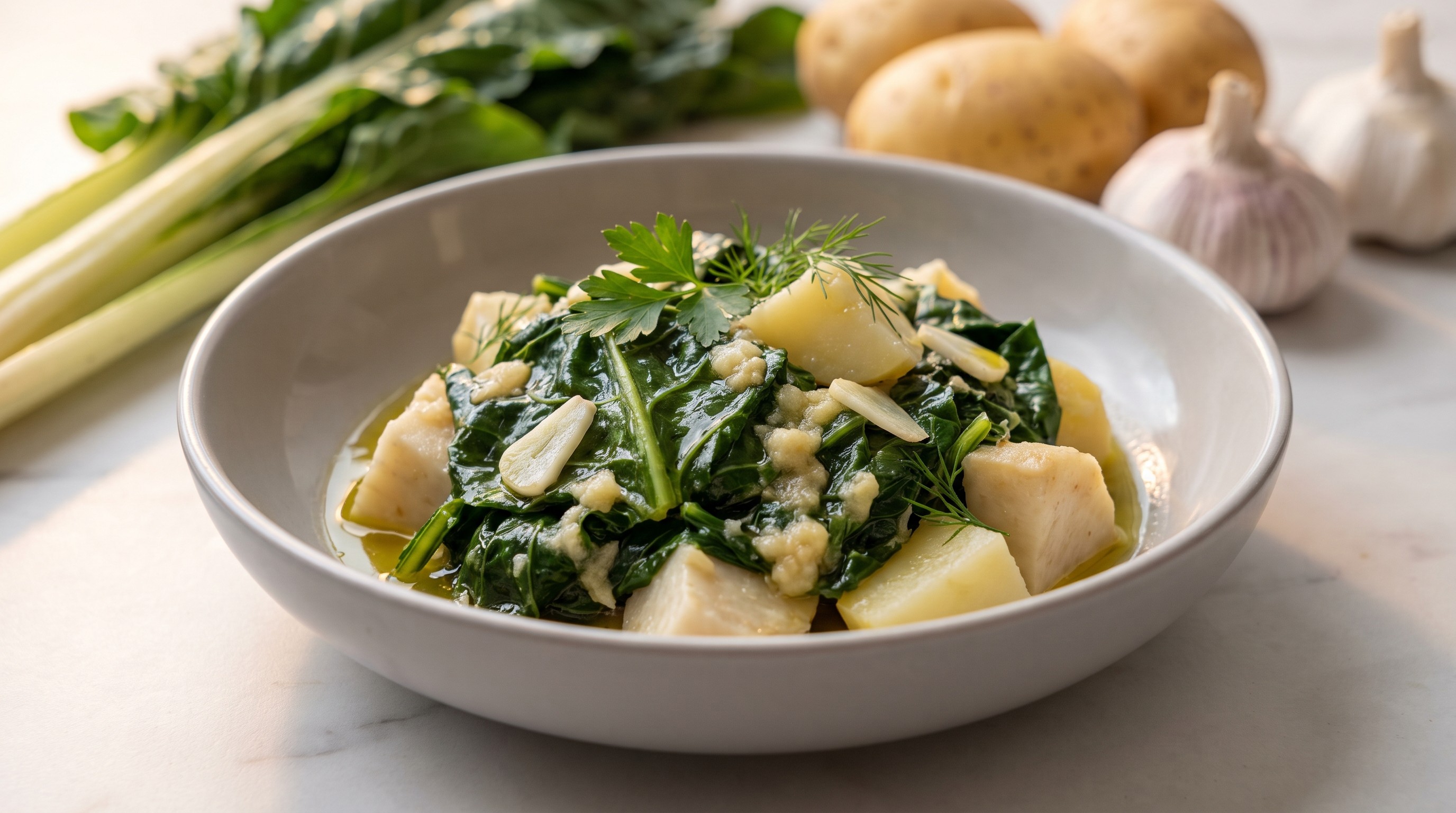
Blitva — Dalmatian Chard with Celeriac and Potato
A blood-sugar-friendly Dalmatian classic: Swiss chard, celeriac and potato crushed with raw garlic and olive oil for a gentle, mineral-rich side.
Blitva is the soul of Dalmatian cooking — greens and potato unified by garlic and good olive oil into something far greater than its parts. This low-glycemic adaptation honours the original by replacing half the potato with celeriac, a root vegetable with roughly a third of the glycemic impact. Each serving contains approximately 75 g of potato and 75 g of celeriac, keeping the glycemic load moderate at 16.
Swiss chard is one of the most blood-sugar-friendly vegetables you can eat. It is virtually carb-free, rich in magnesium — a mineral directly involved in insulin signalling — and loaded with fibre that slows gastric emptying. The generous pour of extra-virgin olive oil adds monounsaturated fat, which clinical studies have shown to flatten post-meal glucose curves when consumed alongside starchy foods. Even the raw garlic plays a role: allicin, the compound released when garlic is crushed, has been linked to modest improvements in fasting glucose.
For the best glycemic outcome, serve blitva alongside grilled fish or another lean protein. Eating the chard and oil first, before the starchier potato-celeriac mixture, can further blunt the glucose response — a simple sequencing trick supported by research. The dish is naturally gluten-free, dairy-free and plant-based, making it a versatile side for almost any dietary pattern focused on metabolic health.
Blood Sugar Impact
Moderate blood sugar rise expected due to the medium glycemic load (16.4) and medium GI (57) driven by the potato content. The celeriac, swiss chard fiber, and olive oil fat help slow glucose absorption, but the starchy potato component will still produce a noticeable postprandial rise over 1-2 hours.
Blood Sugar Tips
- ✓ Eat the swiss chard and celeriac portions first before the potato to leverage the fiber and lower-GI vegetables as a buffer against the glucose spike.
- ✓ Add a source of protein (such as grilled fish or a poached egg) alongside this dish to further slow gastric emptying and flatten the blood sugar curve.
- ✓ Take a 15-20 minute walk after the meal to enhance glucose uptake by muscles and reduce the peak blood sugar response.
🥗 Ingredients
- 150 g Potato
- 150 g Celeriac
- 400 g Swiss chard
- 3 pcs Garlic
- 3 tbsp Extra virgin olive oil
- 1 tsp Sea salt
- 5.3 oz Potato
- 5.3 oz Celeriac
- 14.1 oz Swiss chard
- 3 pcs Garlic
- 3 tbsp Extra virgin olive oil
- 1 tsp Sea salt
👨🍳 Instructions
- 1
Fill a large pot with water, season it lightly with salt, and bring it to a rolling boil over high heat.
- 2
Peel the potato and celeriac and cut both into roughly 2 cm cubes. Drop them into the boiling water together and cook at a steady boil for about 12 minutes, until a knife slides through each cube with little resistance.
- 3
While the roots are simmering, prepare the chard. Strip the leaves from the stems, then slice the stems crosswise into 1 cm pieces. Gather the leaves and chop them roughly into wide ribbons.
- 4
Thinly slice the garlic cloves and set them aside — they will go in raw at the end, so thin, even slices ensure they soften just enough in the residual heat.
- 5
Once the potato and celeriac are tender, add the chard stems to the pot and boil for 3 minutes. Follow with the chard leaves, pushing them under the water, and cook for a further 2 minutes until they are wilted and silky.
- 6
Drain everything thoroughly through a colander. Press the vegetables gently with the back of a spoon and let them sit for about 30 seconds to release excess moisture, then tip them back into the empty pot off the heat.
- 7
Scatter the sliced garlic over the vegetables and pour in the olive oil. Using a wooden spoon, crush and fold the mixture — let some of the potato and celeriac cubes break apart so they coat the greens in a rough, starchy dressing, but stop well short of a smooth mash.
- 8
Taste, adjust with salt as needed, and serve immediately while the garlic is still sharp and the greens are bright. For a gentler blood-sugar response, plate the blitva alongside grilled fish or another protein and eat the greens first.
📊 Nutrition Per Serving
| Per Serving | Whole Dish | |
|---|---|---|
| Calories | 323 | 646 |
| Carbs | 29g | 57g |
| Sugars | 3g | 7g |
| Natural Sugars | 3g | 7g |
| Protein | 9g | 17g |
| Fat | 22g | 43g |
| Saturated Fat | 3g | 6g |
| Unsaturated Fat | 18g | 37g |
| Fiber | 10g | 20g |
| Soluble Fiber | 3g | 6g |
| Insoluble Fiber | 7g | 14g |
| Sodium | 1311mg | 2622mg |
Predicted Glucose Response
What if you...
Estimated model — individual responses vary. Not medical advice.
🔄 Lower GI Swaps
Potato has a high GI of approximately 78. Replacing it fully with celeriac (GI ~35) or turnip (GI ~30) eliminates the highest-GI ingredient and can reduce the glycemic load of the dish to around 8–10 per serving.
All three greens have a negligible glycemic impact. Kale offers slightly more fibre per serving, while spinach cooks faster and has a milder flavour. Both preserve the dish's blood-sugar-friendly profile.
Avocado oil is similarly rich in monounsaturated fats that help slow glucose absorption. It has a more neutral flavour and a higher smoke point, though in this recipe the oil is added off-heat so smoke point is not a factor.
🔬 The Science Behind This Recipe
This recipe keeps blood sugar in check through three complementary mechanisms. First, half the potato is replaced with celeriac, which has a glycemic index of around 35 compared to potato's 78, cutting the total starch load significantly. Each serving delivers roughly 75 g of potato — enough for the authentic texture — alongside 75 g of low-GI celeriac, yielding an estimated glycemic load of 16 per plate.
Second, Swiss chard contributes soluble fibre and magnesium without adding meaningful carbohydrate. Magnesium is a cofactor for over 300 enzymatic reactions including those governing insulin receptor sensitivity; population studies consistently link higher magnesium intake with lower type-2 diabetes risk. The fibre forms a gel-like matrix in the stomach that slows the rate at which glucose enters the bloodstream.
Third, the generous olive oil provides monounsaturated fatty acids that delay gastric emptying. A 2016 trial in the journal Diabetes Care showed that adding fat to a carbohydrate-rich meal reduced the post-meal glucose peak by up to 20 percent. Raw garlic adds allicin, a sulphur compound shown in meta-analyses to modestly reduce fasting blood glucose over sustained intake. Finally, the meal-sequencing tip — eating the greens and fat before the starchy component — leverages research from Weill Cornell Medicine demonstrating that vegetable-first eating order can lower post-meal glucose by roughly 30 percent compared to carbs-first.
Related recipes
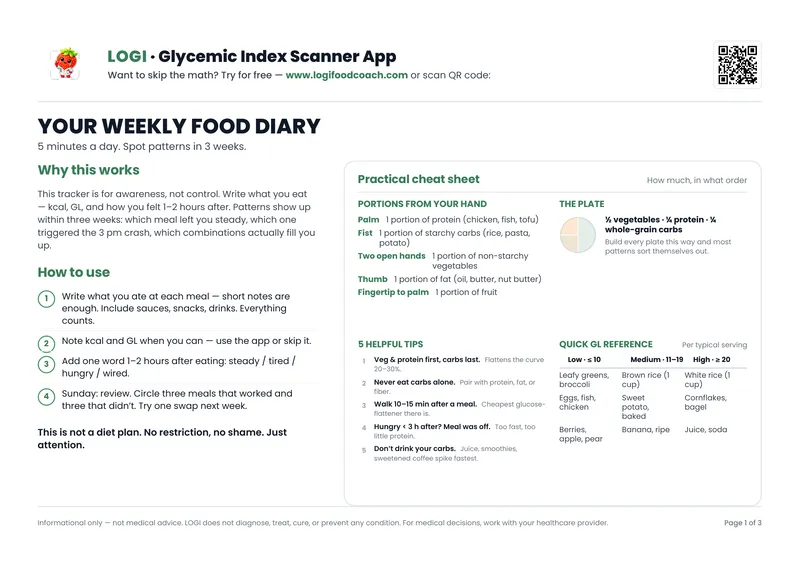
Free PDF — 3 pages
Your Weekly Food Journal
Track meals, glycemic load & mood. Spot patterns in 3 weeks.
No spam. Unsubscribe anytime.