Oats Glycemic Index: Why Steel-Cut, Rolled and Instant Are Three Different Foods
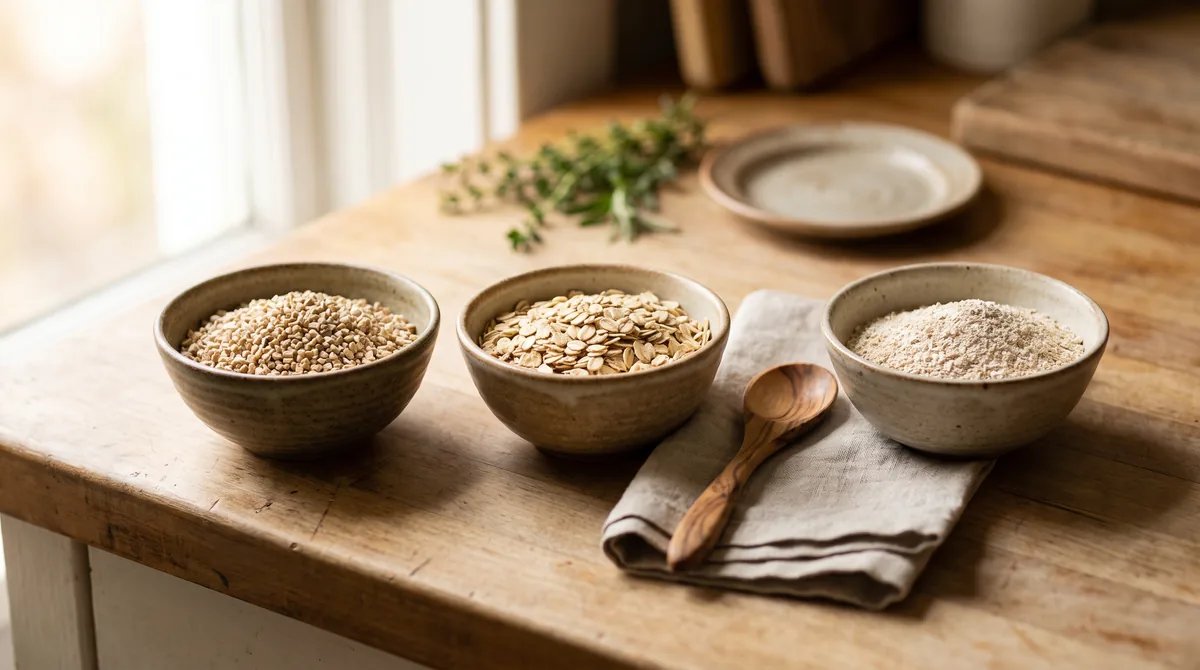
Oats have an unusually good reputation for blood sugar and an unusually wide range of glycemic index values, and the two facts are related. Depending on which form you buy, published GI values for oats run from roughly 52 to the low 80s — a span that crosses the entire low, medium, and high classification without changing a single ingredient. Same grain, same field, same nutritional label in most respects. The difference is processing.
This is why the question “are oats good for insulin resistance?” gets contradictory answers online. The people saying yes are usually eating steel-cut or rolled oats. The people whose morning oatmeal spikes them are usually eating the instant kind. Both are describing their own experience accurately.
The four forms, and what separates them
Every form of oats starts as the same oat groat — the whole kernel with the inedible hull removed. What happens next determines the glycemic response almost entirely.
| Form | What was done to it | Typical GI | GL per 40 g dry serving |
|---|---|---|---|
| Whole oat groats | Nothing beyond hulling | ~52–55 | ~13 |
| Steel-cut (pinhead, Irish) | Groat chopped into 2–3 pieces | ~52–58 | ~14 |
| Rolled (old-fashioned) | Steamed, then flattened between rollers | ~55–59 | ~15 |
| Instant / quick | Pre-cooked, dried, rolled very thin | ~75–83 | ~19–21 |
A 40-gram dry serving — a standard portion, about half a cup of rolled oats — contains roughly 25–27 grams of available carbohydrate in every form. The carbohydrate does not change. Only the speed at which your digestive enzymes can reach it does.
The mechanism is surface area and starch structure. An intact or coarsely cut groat is a dense package: enzymes work inward from the outside, and digestion takes time. Rolling flattens the grain and increases the exposed surface. Instant oats go further — they are fully pre-cooked, which gelatinizes the starch, then dried and rolled thin enough to rehydrate in ninety seconds. Gelatinized starch in a thin flake is close to the most digestible form a cereal carbohydrate can take, which is precisely what makes instant oats convenient and precisely what puts their GI near white bread.
Nothing about instant oats is nutritionally degraded in the usual sense. The fibre is still there, the beta-glucan is largely still there, the micronutrients are still there. What changed is physical structure, and for glycemic response, physical structure is most of the story.
Beta-glucan: the part of the reputation that is earned
Oats’ standing as a blood-sugar food rests on a specific soluble fibre called beta-glucan, which makes up roughly 3–5 percent of the dry weight of oats and behaves quite differently from the insoluble fibre in wheat bran.
Beta-glucan dissolves in water and forms a viscous gel. That viscosity does three things that matter here:
- It slows gastric emptying. The stomach releases a thicker mixture into the small intestine more gradually, so the glucose arrives over a longer window rather than all at once.
- It creates a physical barrier to enzyme access. Starch suspended in a viscous gel is harder for amylase to reach, slowing the rate at which it becomes glucose.
- It slows glucose absorption across the intestinal wall, by thickening the unstirred water layer at the mucosal surface.
The effect is well enough established that European regulators have authorised a health claim for oat beta-glucan on reduction of the post-meal rise in blood glucose, with a threshold of about 4 grams of beta-glucan per 30 grams of available carbohydrate in the meal. In practical terms, a generous 60–80 gram serving of oats gets you into that range; a small 30-gram serving generally does not.
Two caveats keep this honest. First, the viscosity is what does the work, so anything that destroys it reduces the benefit — very long high-heat cooking and heavy mechanical processing both degrade beta-glucan structure. Second, beta-glucan slows the response; it does not cancel the carbohydrate. A large bowl of oats is still a substantial carbohydrate load whatever its GI.
Overnight oats, cooling, and resistant starch
Overnight oats have picked up a reputation as the low-glycemic version, and there is a modest real effect underneath a fairly large amount of overstatement.
Soaking raw rolled oats in liquid overnight hydrates the starch without fully gelatinizing it, and keeping them refrigerated encourages some starch retrogradation — cooked or hydrated starch molecules reorganising into a crystalline form that resists digestion. Retrograded starch functions like fibre: it passes into the large intestine largely intact, feeding gut bacteria rather than raising glucose.
The effect is real but small. Studies on cooking-and-cooling in starchy foods generally find resistant starch increases of a few percentage points of total starch — enough to shift a glycemic response modestly, not enough to convert a high-carbohydrate breakfast into a low-carbohydrate one. The bigger reason overnight oats often perform well is mundane: they are usually made with yoghurt or milk, and frequently with nuts, seeds, or nut butter — meaning the meal contains protein and fat that a bowl of oats in water does not.
That is worth separating clearly, because it is where the practical leverage actually sits. What you add to oats moves the glucose curve more than which oats you bought.
Building a bowl that behaves
A 40-gram serving of rolled oats delivers about 26 grams of carbohydrate and a glycemic load around 15 — squarely medium. That is a real breakfast carbohydrate load, and for someone with insulin resistance it is enough to matter. The additions decide what happens next.
Things that flatten the response:
- Protein. Greek yoghurt, skyr, a scoop of protein powder, or an egg on the side. Protein slows gastric emptying and blunts the peak substantially.
- Fat. Nuts, seeds, nut butter, full-fat dairy. Similar mechanism, and it improves satiety enough to prevent the mid-morning follow-up snack that is often the real problem.
- More beta-glucan. A larger oat portion raises both carbohydrate and beta-glucan; adding oat bran raises beta-glucan without adding much digestible starch, which is the better trade.
- Acidity. A spoonful of yoghurt or a squeeze of lemon slightly slows gastric emptying. A small effect, but free.
- Choosing the coarser cut. Steel-cut over rolled, rolled over instant. Worth roughly 20 GI points from top to bottom of that range.
Things that steepen it:
- Instant sachets, particularly the flavoured ones, which typically add 8–12 grams of sugar to an already fast-digesting base.
- Honey, maple syrup, or dried fruit on top. Dried fruit is the quiet one — a handful of raisins can add as much carbohydrate as the oats themselves.
- Fruit juice or sweetened plant milk as the liquid.
- Cooking to a very smooth porridge, which further gelatinizes the starch. A bowl with some texture left behaves better than one cooked to paste.
A useful default: coarse oats, cooked with milk or water and left slightly toothsome, topped with yoghurt and nuts or seeds, sweetened with a small amount of whole fruit rather than syrup or dried fruit. That is a medium-glycemic-load breakfast with a flattened curve and enough protein and fat to hold until lunch.
What this means if you have insulin resistance
Oats are neither the problem food nor the miracle food they are alternately described as. The honest summary is that they are a medium-glycemic-load carbohydrate with a genuinely useful soluble fibre attached, and their behaviour is unusually sensitive to form and to what you eat alongside them.
If oatmeal has spiked you in the past, the two most likely explanations are that you were eating the instant form, or that you were eating oats essentially alone — carbohydrate with no protein or fat to slow it. Both are fixable without giving up the breakfast.
If you are testing your own response, oats are a good food to run a controlled comparison on, because the variables are easy to isolate: the same 40 grams as instant versus steel-cut, then the same steel-cut with and without yoghurt and nuts. Those two comparisons will tell you more about your own physiology than any published GI table, and the differences are usually large enough to see clearly.
The bigger picture
The oats story is a specific case of a general principle that GI charts obscure by design: a glycemic index value belongs to a food-as-prepared, not to an ingredient. Oats span the full classification range without any change in composition. The same is true, less dramatically, of potatoes, rice, and pasta, all of which shift substantially with cooking method, cooling, and particle size.
This is genuinely good news, because processing and preparation are variables you control completely, and unlike food restriction they cost nothing. Moving from instant sachets to rolled oats, adding yoghurt and nuts, and cooking to texture rather than to paste are three changes that together can move a breakfast from a high-GI, unaccompanied carbohydrate load to a medium-GL meal with a slow curve — while eating the same grain, in the same quantity, at the same time of day.
That is usually a better place to start than eliminating the food, and it is much more likely to survive contact with an ordinary week.
Judging the glycemic load of a bowl that contains oats, yoghurt, berries and nuts is exactly the kind of arithmetic nobody keeps up for long. Logi scans the bowl and estimates the glycemic load of the assembled meal, which is more useful than the GI of any one ingredient in it.
This article is educational. It is not medical advice. Individual responses to any food vary widely; if you have diabetes, insulin resistance, or another metabolic condition, discuss dietary choices with your doctor or a registered dietitian.
Foods in this article
Related recipes

Steel-Cut Oatmeal with Blueberries & Almonds
A blood sugar-friendly breakfast combining slow-digesting oats with protein-rich almonds and antioxidant blueberries for sustained morning energy.

Low-Glycemic Overnight Oats with Berries
A blood sugar-friendly breakfast that combines steel-cut oats with protein-rich Greek yogurt and antioxidant-packed blueberries for sustained energy.

Low-Glycemic Instant Pot Tofu Scramble with Greens
A protein-rich, blood sugar-friendly breakfast ready in 20 minutes. Packed with fiber from greens and tomatoes, this savory scramble keeps you satisfied.
Take control of your blood sugar
Scan your meals, track glycemic load, and see your patterns — all in one app.
Start Free Trial →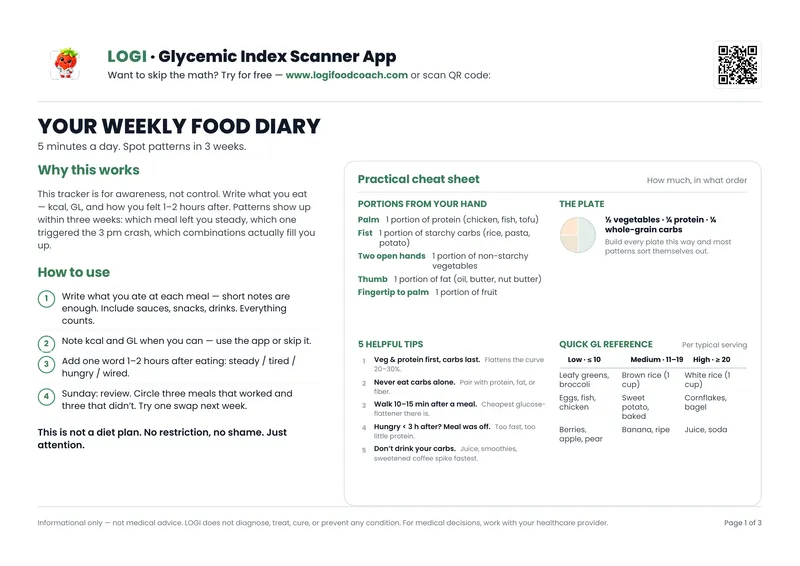
Free PDF — 3 pages
Your Weekly Food Journal
Track meals, glycemic load & mood. Spot patterns in 3 weeks.
No spam. Unsubscribe anytime.