Fruit and Blood Sugar — Why Some Fruits Spike You and Others Don't, and How to Choose Better
“Is fruit good or bad for blood sugar?” — the wrong question
If you have insulin resistance, prediabetes, or PCOS, you have probably heard both answers. One side tells you fruit is nature’s candy and will spike you. The other tells you fruit is whole food and you should eat it freely. Both are partly right and partly wrong, and that is why people stay confused.
A more useful question: how does this specific fruit, eaten this way, with these other foods, affect my glucose? That is a question with a real answer — and the answer changes per fruit, per ripeness, per portion, and per pairing.
This post walks through six fruit families — tropical, berries, stone, citrus, pome, and vine — and the four factors that decide whether a piece of fruit lands softly or hits hard.
The four things that actually decide a fruit’s glycemic impact
1. Sugar mix: fructose vs. glucose vs. sucrose
Fruit sugar is not one thing. Most fruits contain three sugars in different ratios:
- Glucose — raises blood sugar directly and quickly
- Fructose — processed by the liver, very little immediate glucose rise (but excess can drive insulin resistance over years)
- Sucrose — a 50/50 glucose/fructose pair, splits during digestion
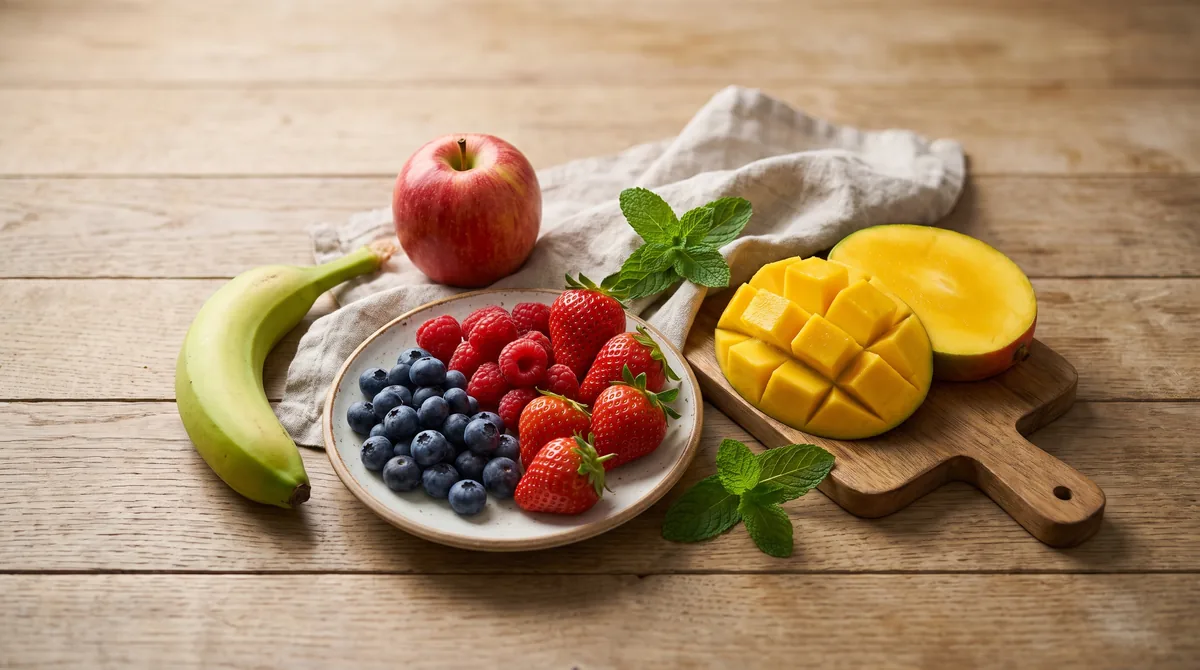
Berries are mostly fructose. Bananas are mostly glucose plus sucrose. Mango is mostly sucrose. That single fact already explains why a cup of strawberries feels different from a banana even at similar carb counts.
2. Fiber load: how much, and where it sits
Whole fruit holds its sugars inside a fiber matrix. Bite, chew, digest. Pectin (apples, citrus, plums), insoluble fiber (berries, kiwi seeds, mango skin), and resistant starch (slightly underripe banana) all slow glucose release. Juice the same fruit and the fiber is gone — the glucose now hits a much faster.
Practical rule: whole fruit ≠ fruit juice ≠ dried fruit. Same plant, three different glycemic profiles.
3. Ripeness
A green banana has roughly half the glycemic load of a brown-spotted banana. Why? Resistant starch converts to free sugars as the fruit ripens. The same applies to mango, papaya, plantain, and many tropical fruits.
If you are blood-sugar sensitive, slightly underripe usually means flatter curve.
4. Pairing
A bowl of grapes alone behaves differently from grapes with a handful of almonds and a piece of cheese. Fat, protein, and fiber slow gastric emptying, which slows glucose absorption. Fruit as dessert after a balanced meal is glycemically very different from fruit as a standalone snack on an empty stomach.
This is the single biggest lever most people miss.
Tropical fruits — the ones most often blamed
Pineapple, mango, banana, papaya, lychee. These are the headline-grabbers.
Pineapple
GI around 59, GL per 100g around 6. Sounds moderate, but most people eat 200-300g in a sitting — a large bowl easily lands at GL 15-20. Pineapple is mostly sucrose. Ripeness matters. Pairing with cottage cheese, Greek yogurt, or a few nuts moves the needle.
Mango
GI 51-55, GL per 100g around 8. A whole ripe mango weighs 300-400g — easily a GL 25 hit. Mango is unusual: high fructose share, modest fiber, sweet enough that you want more. Half a mango with yogurt behaves very differently from a whole mango eaten alone.
Banana
GI changes with ripeness — green 30, just-yellow 51, brown-spotted 60+. A medium banana is around 100g of carbs-equivalent and lands at GL 11-13. Slightly underripe, paired with peanut butter or Greek yogurt, banana is one of the better convenience foods. Brown-spotted, eaten alone, it spikes.
Papaya
GI 60, GL per 100g around 8. Similar to pineapple — moderate fiber, mostly fast sugar, big portions get you in trouble.
Lychee
A surprise visitor at the top of Japanese search queries. GI is low to moderate (50-55), but lychees are tiny and you eat 10-20 of them quickly. Total GL adds up fast. Refreshing in summer; not a free pass.
Tropical fruit rule of thumb: smaller portions than you think, paired with protein/fat, and slightly underripe if possible.
Berries — the easiest fruit family
Blueberries, strawberries, raspberries, blackberries.
GI 25-40 across the board. GL per 100g typically 3-5. High fiber-to-sugar ratio, mostly fructose, lots of polyphenols.
For most people with blood-sugar concerns, berries are the default fruit choice. A full cup of strawberries lands at GL ~3-4. A cup of raspberries is GL ~3. Blueberries are the slightly heavier one (GL ~7) but still gentle.
Frozen berries are fine — sometimes better, because they are picked ripe and frozen quickly. Avoid berry “yogurts” and “smoothies” that bury 30g of added sugar in a fruit-shaped advertisement.
Stone fruits — quiet performers
Peaches, plums, apricots, cherries, nectarines.
GI 30-45. GL per 100g 4-6. Decent fiber, lots of water, moderate sugar.
Cherries deserve a footnote. They have a low GI (around 22) but you eat them by the handful and the total GL climbs. Half a cup of cherries is reasonable; a full bowl is not.
Plums and apricots are often forgotten — both are excellent low-GL choices.
Dried versions are a different food. Dried apricots concentrate sugar 4-5x and lose water. Treat them as a sweet, not a fruit.
Citrus — the underrated category
Oranges, grapefruit, lemons, limes, mandarins.
GI 25-40. GL per 100g 4-7.
Grapefruit is interesting: GI around 25, very low GL, and a long-standing tradition in blood-sugar literature for breakfasts. Just be aware grapefruit can interact with certain medications — if you take statins, blood pressure pills, or immunosuppressants, ask your doctor.
Whole orange ≠ orange juice. A whole orange has roughly 3g of fiber that buffers the sugar. A glass of orange juice (which takes 3-4 oranges to fill) has the sugar without the fiber. The juice will spike you; the whole fruit usually will not.
Pome fruits — the everyday choice
Apples, pears, quince.
Apples GI 36, GL per medium apple around 6. Pears GI 38, similar GL. Both are high in pectin (a soluble fiber that ferments slowly and supports gut microbes).
Apple + a tablespoon of almond butter is one of the steadiest snacks in any glucose chart. The fiber-pectin-protein-fat combination flattens the curve almost completely in most people.
Vine fruits — the trickiest
Grapes, watermelon, melons.
Watermelon has the most misunderstood number in fruit science: GI around 72 (high) but GL per 100g around 4 (low). Both are correct. Watermelon is 90% water, so the actual sugar per serving is small — unless you eat half a watermelon, in which case it absolutely spikes.
Grapes are the opposite story. GI is moderate (50ish) but they are calorie-dense and easy to overeat. A cup of grapes is GL ~10-12. Two cups is GL ~20-24. They are convenient and tasty, which makes portion creep almost guaranteed.
Cantaloupe and honeydew sit between berries and tropical fruits: GI around 65, GL per 100g around 5. Reasonable in small portions, easy to overdo at brunch.
Practical comparison table
| Fruit | Typical GI | GL per realistic serving | Best practice |
|---|---|---|---|
| Blueberries (1 cup) | 53 | 7 | Default berry choice |
| Strawberries (1 cup) | 40 | 3 | Eat freely |
| Raspberries (1 cup) | 32 | 3 | Eat freely |
| Apple (medium) | 36 | 6 | Pair with nut butter |
| Pear (medium) | 38 | 7 | Pair with cheese |
| Grapefruit (half) | 25 | 3 | Excellent breakfast |
| Orange (medium) | 43 | 6 | Whole, not juiced |
| Peach (medium) | 42 | 5 | Naturally low-GL |
| Cherries (½ cup) | 22 | 4 | Watch portions |
| Banana (medium, just-yellow) | 51 | 11 | Pair with protein/fat |
| Mango (½ fruit) | 51 | 12 | Half-portion + yogurt |
| Pineapple (½ cup) | 59 | 7 | Pair with cottage cheese |
| Grapes (1 cup) | 50 | 11 | Watch portions |
| Watermelon (1 cup cubes) | 72 | 5 | Big portions spike |
The numbers above are approximations. Individual response varies — which is exactly why testing your own response with a tool like Logi is more useful than memorizing a chart.
What this means for everyday choices
You do not need to fear fruit. You need to understand portion, ripeness, and pairing.
A short list of upgrades anyone can make today:
- Switch fruit juice for whole fruit. The single biggest glycemic upgrade in this whole post.
- Move fruit from “morning snack on empty stomach” to “after lunch dessert” or “after dinner.” Same fruit, calmer curve.
- Pair tropical fruit with protein or fat. Pineapple with cottage cheese. Mango with Greek yogurt. Banana with almond butter. Watermelon with feta (yes, really).
- Choose slightly underripe over very ripe for blood-sugar-sensitive fruits like banana and mango.
- Treat dried fruit as a sweet, not a fruit. Three dried apricots ≈ a small candy bar in sugar terms.
What to do when you are not sure
Fruit is genuinely one of the most individual foods. Two people can eat the same banana and see very different glucose curves — depending on insulin sensitivity, what they ate before, time of day, sleep, and activity level.
If you want to learn how your own body responds, the most reliable approach is to:
- Pick one fruit at a time.
- Eat a defined portion the same way two or three times.
- Note how you feel one and two hours after.
A blood-sugar app like Logi makes this easier — log the food, see the predicted curve, and check it against your own sense of how the meal landed.
You are not trying to make fruit complicated. You are trying to find the fruits that feel good in your body, in the portions that suit your week.
A note on medical context
This post is meant to help you learn how different fruits behave in glucose terms. It is not medical advice. If you have diabetes, take blood sugar medication, or have any condition that affects how your body handles carbohydrates, please talk to your doctor or a registered dietitian before changing what you eat.
If you are noticing patterns that worry you — unexplained spikes, very low energy after eating, weight changes — those are conversations for a professional, not a blog post.
Quick reference: fruits to default to, fruits to portion carefully
Default to (eat freely most days):
- Berries (all of them)
- Apples
- Pears
- Grapefruit
- Oranges (whole, not juiced)
- Plums, peaches, apricots
Portion carefully:
- Banana (especially ripe)
- Mango
- Pineapple
- Grapes
- Watermelon (in volume)
- Dried fruit of any kind
Watch for surprises:
- Lychee (small fruit, big totals)
- Cherries (eat by handful)
- Tropical drinks marketed as “natural” (juice is juice)
Fruit is one of the great pleasures of eating. The point of any of this is not to take that away — it is to help you keep more of the fruit you love while finding the portions and pairings that feel steady.
Try one swap this week. See how it lands. Then try another.
Take control of your blood sugar
Scan your meals, track glycemic load, and see your patterns — all in one app.
開始免費試用 →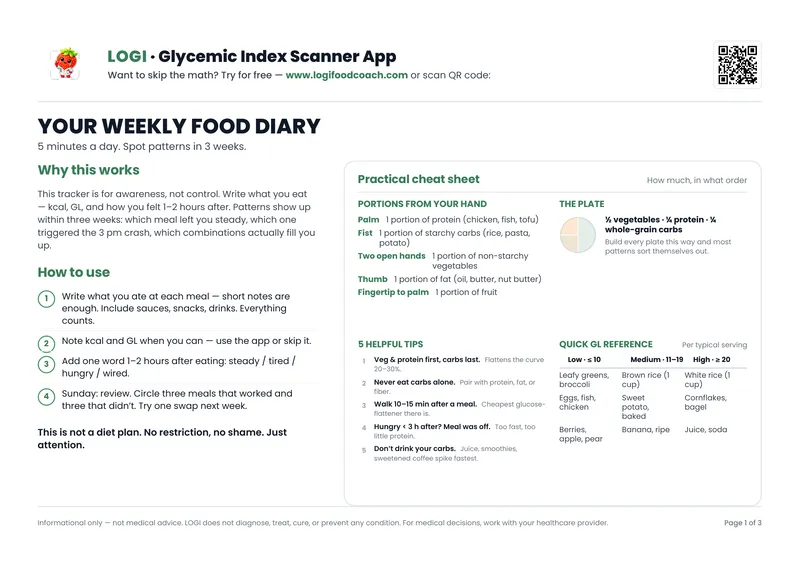
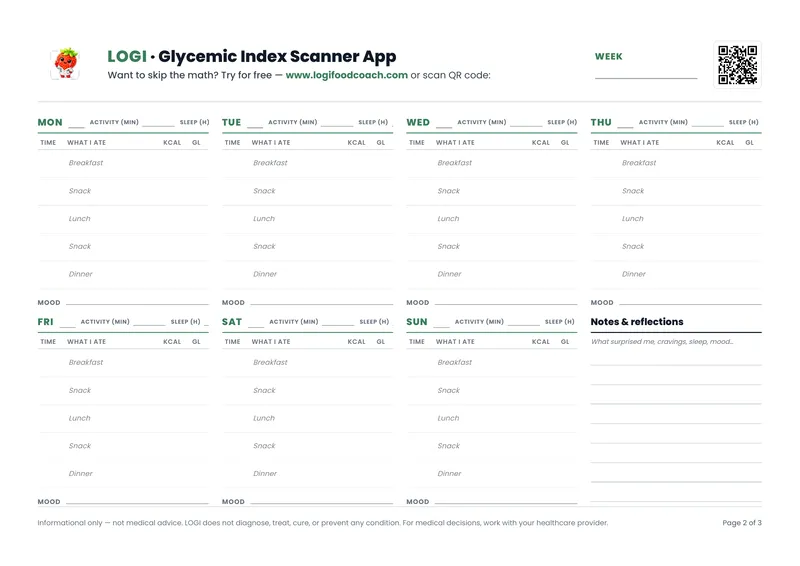
免費PDF — 3頁
每週飲食日誌
記錄飲食、升糖負荷與心情。3週內發現規律。
無垃圾郵件。隨時取消訂閱。