Does Eating Late at Night Raise Blood Sugar? The Circadian Story Behind Evening Meals
Does Eating Late at Night Raise Blood Sugar? The Circadian Story Behind Evening Meals
If you have been paying attention to your glucose curve, you may have noticed something odd: the same dinner produces a bigger spike than the same lunch. A bowl of pasta at 1 pm behaves differently than a bowl of pasta at 9 pm, even when the food is identical, the portion is identical, and the person eating it is the same. This is not a mistake or a measurement quirk. It is one of the most reliable findings in modern metabolic research, and it has real consequences for anyone managing insulin resistance, prediabetes, or type 2 diabetes.
This piece explains why evening meals hit harder than morning or midday ones, what changes across the day inside your body to make that so, and what practical adjustments help if your schedule pushes dinner into the late-evening or nighttime hours.
The mechanism — your body runs on a clock, and that clock includes glucose
Human physiology is not the same at 8 am as it is at 10 pm. Almost every metabolic system in the body follows a daily rhythm — the circadian clock — set primarily by daylight exposure and reinforced by meal timing. Insulin sensitivity, glucose tolerance, cortisol levels, growth hormone release, and the pancreas’s readiness to release insulin all follow this rhythm.
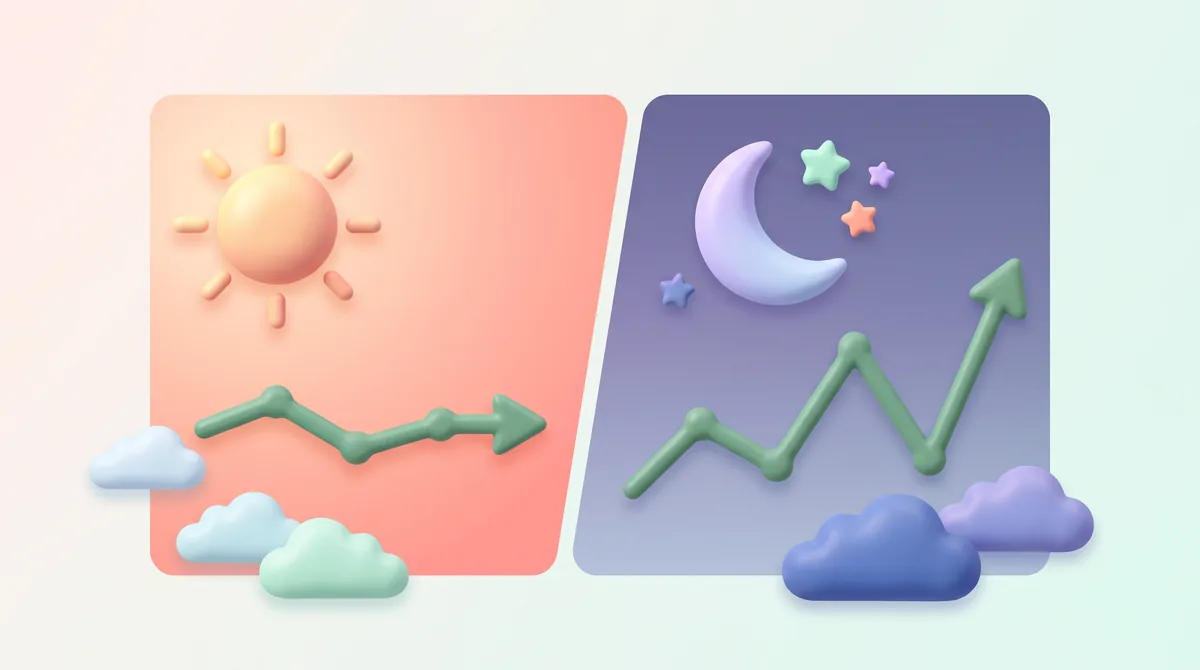
Two features of that rhythm matter most for blood sugar. First, insulin sensitivity — how well your cells respond to insulin’s signal to take up glucose — is highest in the morning and early afternoon and drops through the evening. Second, the pancreatic beta cells that release insulin are more efficient earlier in the day and less responsive at night. Combined, the result is: the same amount of glucose entering your bloodstream late in the evening produces a bigger, longer-lasting spike than it would earlier in the day.
Studies using controlled meals show this effect clearly. A standardized meal eaten at 8 pm produces a glucose response 20–40% larger than the same meal eaten at 8 am in the same person, and the response takes longer to return to baseline. For someone with insulin resistance, where the response was already exaggerated at midday, the evening version can be dramatically worse.
Result: the timing of a meal is a real variable, not just a matter of routine. Eating late — either a late dinner, or eating again after dinner — makes glucose control harder, regardless of what the meal contains.
Cortisol, melatonin, and why the evening is metabolically different
The circadian pattern of glucose tolerance has two hormonal drivers worth knowing about, because they explain not only the “evening is worse” pattern but also its edge cases.
Cortisol is a stress hormone that also serves as a metabolic wake-up signal. It peaks in the morning (part of what gets you out of bed), stays elevated through midday, and drops in the evening. Cortisol raises blood glucose by pushing the liver to release stored glucose, but it also primes insulin sensitivity — the morning cortisol peak is part of why insulin works so efficiently at breakfast, once you’ve been up long enough for the cortisol response to have primed the system. Late at night, cortisol is low; insulin sensitivity is correspondingly reduced.
Melatonin rises in the evening in preparation for sleep and directly suppresses insulin release. Studies where subjects were given melatonin supplements immediately before eating showed sharply impaired glucose tolerance compared to control meals. This means that as your natural melatonin rises in the evening — starting around sunset and peaking during sleep — your ability to release insulin in response to food declines. A meal eaten in the low-melatonin daytime state gets a bigger insulin release; a meal eaten in the high-melatonin evening state gets a weaker one.
These two rhythms together are why evening eating produces bigger spikes, and they also explain a subtler observation: people whose cortisol rhythm is disrupted (chronic stress, shift work, jet lag) or whose melatonin exposure is atypical (screen light late at night, disrupted sleep) tend to have worse glucose control even at the same food intake. The clock matters, and its inputs matter.
What “late” actually means
The evening glucose tolerance drop is not a sudden switch at any particular clock time. It follows a gradient across the day, and the “worst” hour depends on the individual — mostly on their sleep timing and light exposure pattern. Some rough anchors from the research:
- Insulin sensitivity is highest in the first 4–6 hours after waking, when cortisol has primed the system and melatonin has fallen away.
- It is roughly stable through midday.
- It begins declining in the mid-to-late afternoon.
- It drops noticeably 2–3 hours before habitual bedtime.
- It is at its lowest during sleep and in the middle of the night.
For someone with a fairly standard 7 am wake / 11 pm sleep pattern, that means glucose tolerance is best from about 8 am to 3 pm, moderate from 3 pm to 7 pm, and meaningfully worse from 8 pm onward. A shift worker or someone with a very late chronotype has a shifted version of the same curve but the shape is the same.
The practical implication: “eating late” is not a fixed clock time. It is defined relative to your own bedtime and light exposure. A 10 pm dinner for someone who goes to bed at 11 is metabolically the same as a 6 pm dinner for someone who goes to bed at 7. What matters is proximity to sleep, not the number on the clock.
The night snacking problem
Beyond dinner timing, a separate but related issue is post-dinner eating — grazing after the evening meal until bedtime. This is the pattern most associated with poor glucose control in people managing insulin resistance, and it has two mechanisms working against it.
First, the meal itself is now late by definition, so the base glucose response is already amplified. Second, night snacks are typically fast-absorbing carbohydrates or sweets — the kinds of foods people reach for when the goal is comfort or reward rather than nutrition. A bowl of pretzels at 10 pm, a piece of dessert at 10:30, and a small bowl of ice cream at 11 will produce three overlapping glucose peaks, none of which fully clear before sleep. Fasting glucose the next morning is measurably higher after evenings like this than after evenings that end with dinner.
The behavioral pattern also feeds itself: high evening glucose is followed by poorer sleep quality (glucose fluctuations disturb sleep), which is followed by higher cortisol the next day, which is followed by increased appetite the next evening, which increases the temptation to snack. It is a common feedback loop and it is worth naming: the metabolic argument for “kitchen closes after dinner” is not moralistic, it is mechanical.
What to do if late meals are unavoidable
Not everyone can eat dinner at 5 pm. Shift work, family schedules, cultural norms, and the ordinary rhythm of an evening after work all push meals later. If the choice is between a late dinner and no dinner, a late dinner is clearly the right answer. But the meal can be built to minimize the circadian penalty.
Front-load the day. If dinner has to be late, make breakfast and lunch the larger meals. Insulin sensitivity is best in the morning, so calories eaten then produce smaller responses and are handled more efficiently. A big breakfast, a substantial lunch, and a smaller late dinner shifts the load into hours where the body is metabolically prepared for it.
Make the late meal lower in fast carbohydrate. The circadian evening penalty falls hardest on refined carbohydrate (bread, pasta, rice, potato, sugar) and less hard on protein, fat, and non-starchy vegetables. A late dinner of grilled fish with vegetables and olive oil produces a small evening spike; a late dinner of pasta with cream sauce and bread produces a very large one. Save the carb-dominant meals for lunch when possible.
Add vinegar or a small salad first. The order-of-eating trick — vegetables and protein before starch — helps at any meal and helps more in the evening because the extra buffering time matters when the insulin response is already impaired. A small vinaigrette-dressed salad before the main course has been shown to blunt the following meal’s peak by 15–30%.
Walk after eating. A 10–15 minute walk after dinner is one of the highest-leverage habits in glucose management, and its effect is proportionally larger for evening meals because muscle glucose uptake (which walking activates) becomes an alternative to insulin — and insulin is what has just become less efficient. Even a short walk cuts the post-dinner peak substantially.
Close the kitchen after dinner. The single biggest reduction in evening glucose load is to end eating at dinner, not to graze afterward. This is more about behavior than food choice — if the last thing you eat is a normal dinner at 8 pm and then nothing else, your fasting glucose the next morning will typically be measurably lower than if you eat again at 10 or 11 pm, even if what you eat then is small.
The night before, and the morning after
One consequence of the evening pattern that is easy to miss: what you eat late affects the next morning’s fasting glucose. A late high-carb dinner produces elevated glucose that persists into the night, and while the levels fall during sleep, they often do not return to the same baseline they would have reached from an earlier, lighter dinner. People who monitor fasting glucose closely often discover that their morning numbers vary more with the previous evening’s timing than with almost anything else.
This also connects to the “dawn phenomenon” — the rise in blood glucose that many people with insulin resistance experience in the early morning as cortisol rises to prepare the body for waking. The dawn rise is a normal physiological event, but its size is worse in people with elevated overnight glucose. Reducing the previous night’s evening meal load tends to reduce the dawn rise’s size the next day.
The bigger picture
Blood sugar management is often framed as being about what you eat. The circadian evidence adds another dimension: when you eat matters too, and the same food is not the same food at different times of day. Eating your largest meal in the morning and your smallest in the evening — the opposite of the standard modern schedule — is more metabolically friendly than the reverse, and it costs nothing.
For someone managing insulin resistance, this reframe is useful because it opens up a lever that requires no willpower and no elimination. You do not have to give up dinner, or give up carbs, or count anything new. You just have to make peace with the idea that a big meal at 9 pm is not the same input as a big meal at 12 pm — and either shift more of your intake earlier, or make the evening meal a smaller and simpler one.
If you want to see how your own glucose responds to the same meal at different times, Logi can log the meal, the estimated glycemic load, and the time — over a few weeks the pattern usually becomes visible.
This article is educational. It is not medical advice. Individual responses to any food vary widely; if you have diabetes, insulin resistance, or another metabolic condition, discuss dietary choices with your doctor or a registered dietitian.
Take control of your blood sugar
Scan your meals, track glycemic load, and see your patterns — all in one app.
เริ่มทดลองฟรี →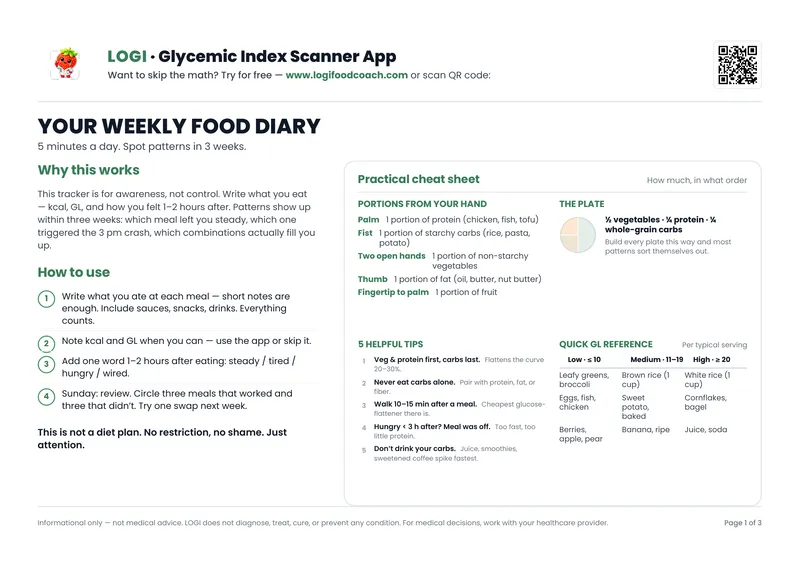
PDF ฟรี — 3 หน้า
สมุดบันทึกอาหารประจำสัปดาห์
บันทึกมื้ออาหาร ค่า GL และอารมณ์ พบรูปแบบใน 3 สัปดาห์
ไม่มีสแปม ยกเลิกได้ทุกเมื่อ