Milk, Oat Milk, and Blood Sugar — What Your Latte Is Actually Doing

Milk, Oat Milk, and Blood Sugar — What Your Latte Is Actually Doing
Nobody thinks about milk as a blood sugar decision. It is the background of the diet — a splash in coffee, a pour over cereal, the base of a smoothie. And for most of history that instinct was roughly right: dairy milk is one of the gentler things you can drink.
Then the milk aisle exploded. Oat, almond, soy, rice, coconut, pea — a dozen white liquids, all called milk, all marketed as light and plant-based and vaguely virtuous. Glycemically, they have almost nothing in common. The gap between the gentlest and the harshest option in that aisle is wider than the gap between most breads, and the one currently winning the popularity contest — oat milk — sits on the wrong end of it.
This piece walks through dairy milk and the major plant milks, what each one does to blood sugar and why, what that means for the two places milk actually enters your day — coffee and breakfast — and how to choose without giving up your latte.
The mechanism — what makes a “milk” spike or not
Every milk is water plus some mix of three things: carbohydrate, protein, and fat. Where those come from decides everything.
The carbohydrate type. Dairy milk’s carbohydrate is lactose, a sugar that digests into glucose and galactose — and galactose barely moves blood glucose. Plant milks made from nuts or beans carry very little carbohydrate at all, unless sugar is added. But milks made from grains — oat and rice — are different: their carbohydrate is starch that has been deliberately broken down during production, and it behaves like the fast sugar it has become.
The processing. To turn oats into a drinkable liquid, manufacturers use enzymes to split oat starch into smaller sugars, mainly maltose. That enzymatic step is why oat milk tastes naturally sweet with no sugar on the ingredient list — the sweetness was manufactured from the starch. Maltose is one of the fastest-acting sugars there is. Oat milk is, glycemically, a lightly sweetened drink that happens to be made from a healthy grain. The fiber that makes a bowl of whole oats slow was mostly filtered out or diluted along the way.
Protein and fat. Dairy milk brings meaningful protein and (unless skimmed) fat, both of which slow everything down. Soy and pea milks bring protein too. Almond, coconut, rice, and most oat milks bring almost none — so nothing brakes whatever carbohydrate they carry.
Dairy milk — the gentle default
Plain cow’s milk is a low-glycemic drink. Lactose digests slowly, half of it becomes galactose rather than glucose, and the protein and fat slow gastric emptying. Whole milk is gentler than skim — the fat is doing work — but even skim milk sits comfortably in the low range.
One honest footnote: dairy raises insulin more than its modest glucose effect would predict. Milk proteins, whey in particular, are insulinotropic — they prompt an insulin response of their own. For most people, including most people with insulin resistance, this is not a practical problem in normal amounts, and dairy protein’s satiety effect is genuinely useful. But it is why “milk barely moves glucose” and “milk is metabolically inert” are not the same claim.
Fermented dairy — kefir, plain yogurt — is gentler still: fermentation eats part of the lactose, and the acidity slows digestion. Plain, unsweetened versions, that is. A flavored fruit yogurt or sweetened drinking yogurt is a dessert in a health costume, with added sugar doing exactly what added sugar does.
Oat milk — the surprise in the aisle
Oat milk earned its place through taste and foam: it is the barista’s plant milk, creamy and naturally sweet. That natural sweetness is the tell. As described above, the production process pre-digests the oat starch into maltose — fast sugar — and strips most of the fiber that redeems whole oats.
The result: oat milk carries more available carbohydrate than any common milk except rice milk, in a fast-acting form, with little protein or fat to slow it. “Barista” versions add oil for texture, which helps the curve slightly, and some brands add sugar on top of the maltose that is already there.
Context matters. A splash of oat milk in one coffee is a trivial amount of carbohydrate — not worth a second thought. A large oat-milk latte is a different object: a full glass of maltose-sweetened liquid, often the first thing in the morning on an empty stomach, when many people with insulin resistance are at their most glucose-reactive. Two or three of those a day is a recurring sugar drip that never registers as “sugar” mentally, because the label says oats.
If you love oat milk, the fixes are boring and effective: smaller drinks, unsweetened brands, ideally with or after food rather than on an empty stomach.
Almond milk — glycemically almost invisible
Unsweetened almond milk is mostly water with a small amount of almond. It carries almost no carbohydrate, a trace of fat, and very little protein. Blood sugar barely notices it. For coffee, cereal, or smoothies where you want liquid without a glucose event, unsweetened almond milk is the quiet winner.
The trap is the default carton: many almond milks are sweetened, and the sweetened versions undo the entire point. “Unsweetened” on the label is the only word that matters. The same logic applies to cashew and macadamia milks, and to coconut milk beverages — very low carbohydrate, more fat, glycemically quiet in normal amounts.
Soy milk — the plant milk that behaves like milk
Unsweetened soy milk is the plant milk that most resembles dairy where it counts: real protein, moderate fat, little carbohydrate. It is low-glycemic, it froths acceptably, and the protein gives it some of dairy’s satiety. Pea-protein milks follow the same pattern.
For someone with insulin resistance who wants a plant-based default across coffee, cereal, and cooking, unsweetened soy is the strongest all-round candidate. As always, the sweetened and flavored versions are different products; vanilla soy milk can carry as much added sugar as a soft drink.
Rice milk — the top of the scale
Rice milk is the harshest common option: grain starch, heavily broken down, almost no protein, fat, or fiber. It tests at the top of the milk category — a high-glycemic drink by any reasonable standard. It exists mainly as an allergy-friendly fallback, being free of dairy, soy, and nuts. If that is why it is in your fridge, treat it like a sweet drink: small amounts, with food. If you drink it by the glass for health reasons, the health reasons have been mislabeled.
The latte question — where this actually lands in your day
Almost nobody drinks milk in isolation; they drink coffee with milk, often several times a day. The daily arithmetic is what matters.
- Espresso, macchiato, cortado, flat white — the milk volume is small; any unsweetened milk is fine, including oat.
- Large lattes and cappuccinos, multiple per day — the milk becomes a food. Dairy, unsweetened soy, or unsweetened almond keep it a non-event. Large oat-milk versions, especially on an empty stomach, are a real carbohydrate dose each time.
- Flavored anything — a pump of syrup outweighs the entire milk decision. The vanilla oat latte’s problem is only partly the oat.
The same logic covers cereal and smoothies: whatever sits under your granola or behind your blended fruit is either braking the meal (dairy, soy) or accelerating it (oat, rice, anything sweetened).
How to choose — a short honest ranking
For blood sugar purposes, unsweetened versions assumed:
- Gentlest: almond, coconut beverage, cashew — barely register.
- Gentle with benefits: dairy milk, soy milk, pea milk, kefir, plain yogurt — low glycemic impact plus protein and satiety.
- Middle, dose-dependent: oat milk — trivial as a splash, meaningful as a habit of large glasses.
- Treat as a sweet drink: rice milk, and any milk with sugar, syrup, or “flavor” added.
Nobody needs to memorize numbers here. One question does most of the work: does this milk taste sweet, and did anyone add sugar to make it so? If it tastes sweet and the label says no added sugar, the sweetness was manufactured from starch — and your bloodstream will treat it as the sugar it is.
The bigger picture
The milk aisle is a case study in how health marketing outruns physiology. “Plant-based” describes botany, not blood sugar. The plant milks span the entire glycemic spectrum, from almost-water (almond) to sweet-drink (rice), with the most fashionable option (oat) quietly sitting in the upper-middle — while boring old cow’s milk and soy milk, the two drinks the trend left behind, remain the gentlest genuinely nourishing options in the category.
None of this says you must abandon oat milk. It says the choice should be made with open eyes: know which milks are background noise and which are a carbohydrate dose, match the milk to the size of the drink, and spend your glucose budget where you actually taste it.
Wondering what your usual coffee order does to your glucose? With Logi you log the drink — latte, milk and all — and see the estimated glycemic load in seconds. Two weeks free. Download Logi.
This article is general nutrition education, not medical advice. If you are managing diabetes, insulin resistance, or another condition, discuss dietary changes with your doctor or a registered dietitian.
Take control of your blood sugar
Scan your meals, track glycemic load, and see your patterns — all in one app.
Começar Teste Gratuito →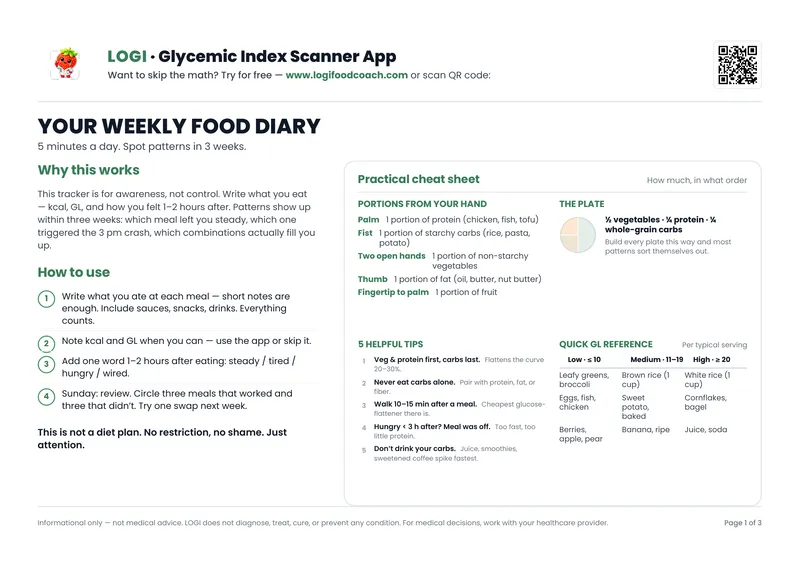
PDF grátis — 3 páginas
O teu diário alimentar semanal
Regista refeições, carga glicémica e humor. Descobre padrões em 3 semanas.
Sem spam. Cancela quando quiseres.