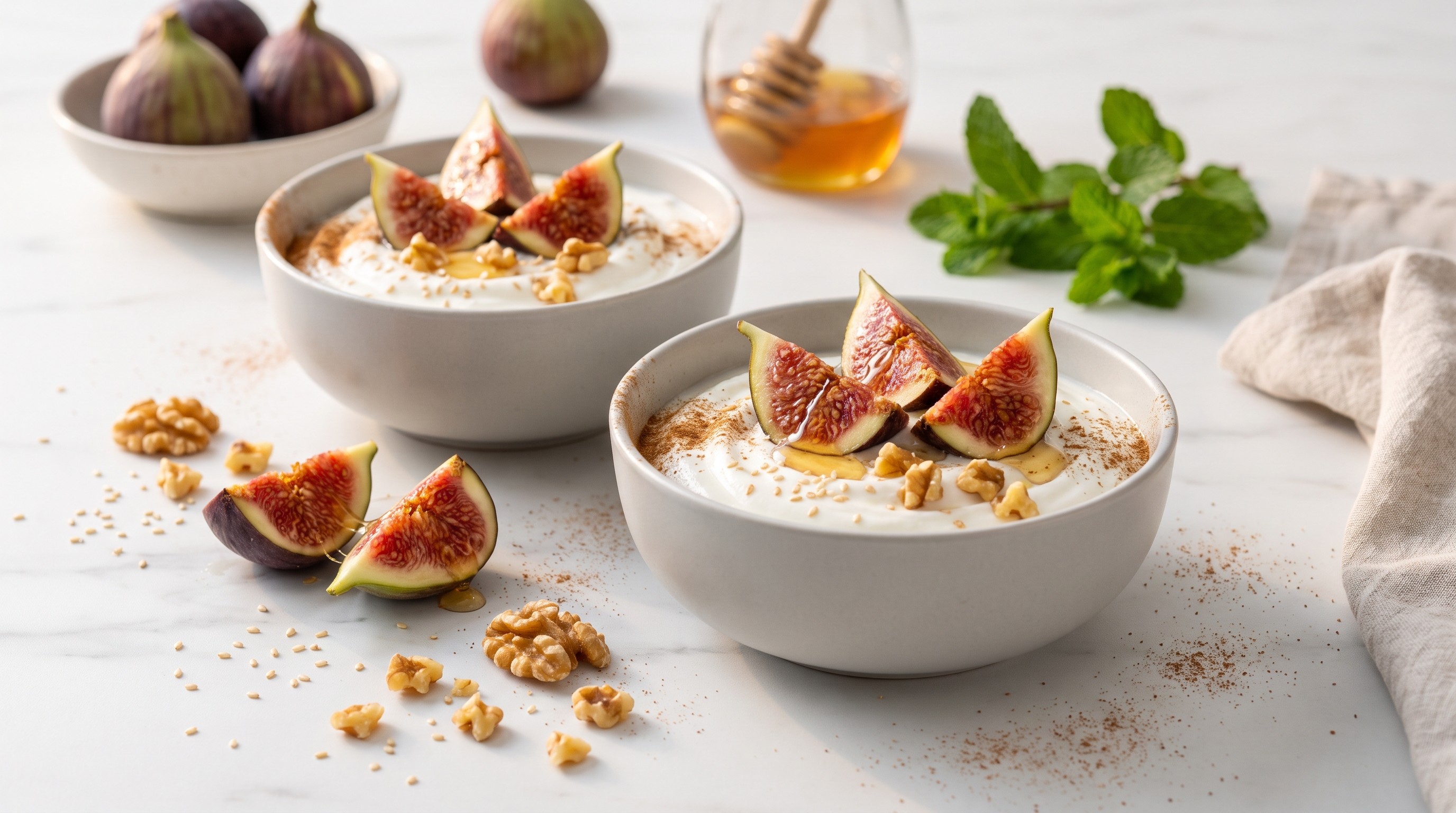
Yiaourti me Meli with Fresh Figs
Creamy full-fat Greek yogurt topped with toasted walnuts, ripe figs, and a restrained honey drizzle — a protein-rich breakfast that keeps blood sugar steady.
This Greek classic proves that blood-sugar-friendly eating can feel indulgent. A generous bed of full-fat strained yogurt supplies roughly 10 g of protein per serving alongside satiating dairy fat, both of which slow gastric emptying and flatten the post-meal glucose curve. The result is steady energy rather than a spike-and-crash cycle — exactly what you want first thing in the morning.
Fresh figs bring natural sweetness with a medium glycemic index (around 61), but their soluble fibre slows sugar absorption considerably, especially when eaten on top of a protein-and-fat base like Greek yogurt. Toasted walnuts contribute omega-3 fatty acids and add a second layer of glucose-buffering fat, while sesame seeds deliver calcium and a subtle nuttiness. Honey is kept to a single teaspoon per bowl — just enough to pool in the yogurt's hollows without meaningfully raising the glycemic load of the dish. A dusting of cinnamon is more than decorative: studies suggest that compounds in cassia cinnamon may improve insulin sensitivity over time.
For the best glucose response, eat a few bites of the walnut-and-fig topping before spooning into the yogurt — consuming fibre and fat before carbohydrates has been shown to reduce post-meal blood sugar by up to 30 %. This bowl pairs beautifully with a small cup of black coffee or unsweetened green tea, and it holds well for a mid-morning meal if you prefer to push breakfast a little later.
Blood Sugar Impact
Low to moderate impact — the protein and fat from full-fat Greek yogurt and walnuts significantly slow glucose absorption, while the honey and fresh figs contribute moderate natural sugars. With a GL of 10 and estimated GI of 33, expect a gentle, sustained rise in blood sugar rather than a sharp spike.
Blood Sugar Tips
- ✓ Eat the walnuts and yogurt first before drizzling the honey, so the fat and protein create a buffer that slows sugar absorption.
- ✓ Use the honey sparingly by drizzling it in a thin stream rather than spooning it — even halving the amount will noticeably reduce the glycemic load while the figs provide natural sweetness.
- ✓ Follow the meal with a short 10-15 minute walk to activate glucose uptake by your muscles and flatten any residual blood sugar rise.
🥗 Ingredients
- 400 g Greek yogurt
- 60 g Walnut halves
- 2 pcs Fresh fig
- 2 tsp Honey
- 10 g Sesame seeds
- 0.5 tsp Cinnamon
- 14.1 oz Greek yogurt
- 2.1 oz Walnut halves
- 2 pcs Fresh fig
- 2 tsp Honey
- 0.4 oz Sesame seeds
- 0.5 tsp Cinnamon
👨🍳 Instructions
- 1
Place the walnut halves in a dry frying pan set over medium heat. Toast for 3 to 4 minutes, shaking the pan every 30 seconds, until the nuts smell fragrant and turn lightly golden at the edges. Transfer to a cutting board, let cool for a minute, then chop roughly into irregular pieces — a mix of halves and smaller shards gives the best texture.
- 2
Rinse the figs gently and pat dry. Trim the tough stem tip from each fig, then cut each one lengthwise into quarters.
- 3
Spoon 200 g of Greek yogurt into each of two wide, shallow bowls. Use the back of the spoon to spread it into a thick, even layer that reaches close to the rim — this creates a generous canvas for the toppings.
- 4
Arrange four fig quarters over each bowl of yogurt, placing them cut side up so their jewel-toned interior is visible. Scatter the chopped toasted walnuts evenly over both bowls, then sprinkle the sesame seeds on top.
- 5
Drizzle exactly one teaspoon of honey over each serving in a thin, slow stream, letting it pool naturally in the hollows of the yogurt. Be precise with the measurement — even a small overage noticeably raises the glycemic load of this otherwise low-GL dish.
- 6
Finish each bowl with a light dusting of ground cinnamon. Serve immediately, starting with a few bites of the fibre-rich fig and walnut topping before mixing into the yogurt — eating fibre and fat before carbohydrates helps blunt the glucose response.
📊 Nutrition Per Serving
| Per Serving | Whole Dish | |
|---|---|---|
| Calories | 532 | 1064 |
| Carbs | 30g | 60g |
| Sugars | 23g | 47g |
| Natural Sugars | 23g | 47g |
| Protein | 23g | 46g |
| Fat | 42g | 84g |
| Saturated Fat | 15g | 30g |
| Unsaturated Fat | 26g | 52g |
| Fiber | 5g | 9g |
| Soluble Fiber | 1g | 3g |
| Insoluble Fiber | 3g | 6g |
| Sodium | 82mg | 164mg |
Predicted Glucose Response
What if you...
Estimated model — individual responses vary. Not medical advice.
🔄 Lower GI Swaps
Honey has a glycemic index of 58–62. While one teaspoon per serving is a controlled amount, swapping it out can reduce the dish's glycemic load from 10 to approximately 7, making it an even gentler option for blood sugar management.
Fresh figs have a medium glycemic index of around 61. Berries offer a lower-GI alternative (GI 25–40) with more fibre per gram of sugar, resulting in a gentler blood sugar response while still providing natural sweetness and visual appeal.
🔬 The Science Behind This Recipe
Why This Works for Your Blood Sugar
This yogurt bowl is built around a simple principle: surround any source of sugar with protein, fat, and fibre so it enters the bloodstream slowly. Full-fat Greek yogurt delivers roughly 10 g of protein and 5 g of fat per serving, both of which delay gastric emptying — the rate at which food leaves your stomach and begins raising blood glucose. The slower that process, the flatter your post-meal glucose curve.
Fresh figs have a medium glycemic index (around 61 on their own), but their soluble fibre forms a gel-like matrix during digestion that slows the release of their natural sugars. Paired with the yogurt's protein-fat base, the effective glycemic impact drops considerably. Toasted walnuts add a second fat source rich in omega-3 fatty acids, reinforcing the glucose-buffering effect.
Honey is the highest-GI ingredient here (GI 58–62), which is why the recipe caps it at one teaspoon per bowl. At that quantity it contributes only about 6 g of sugar — enough for flavour, not enough to shift the glycemic load meaningfully. If you prefer to skip the honey entirely, a few drops of monk fruit sweetener or a drizzle of yacon syrup provide sweetness with virtually no blood sugar impact.
Finally, cinnamon is more than a garnish. Research suggests that bioactive compounds in cassia cinnamon can modestly improve insulin sensitivity over time, helping your cells take up glucose more efficiently. The estimated glycemic index of this complete dish is around 33 with a glycemic load of 10 — well within the low-impact range for a satisfying breakfast.
Related recipes
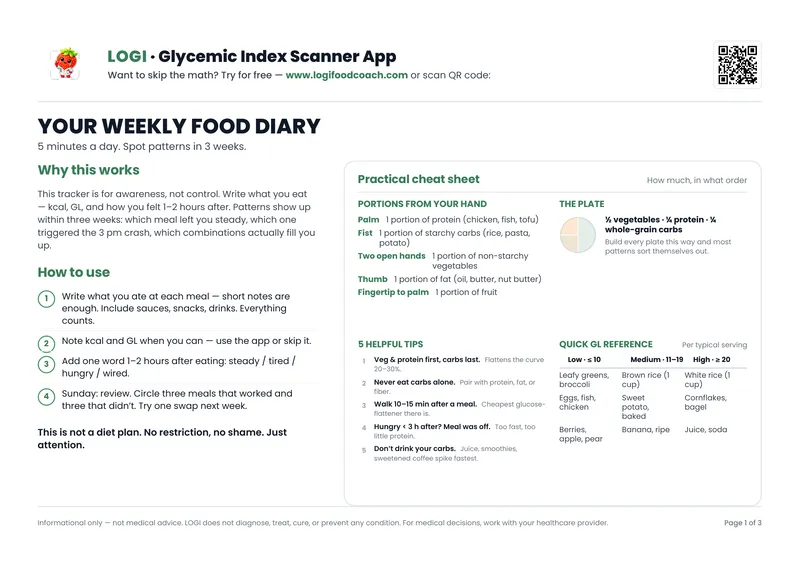
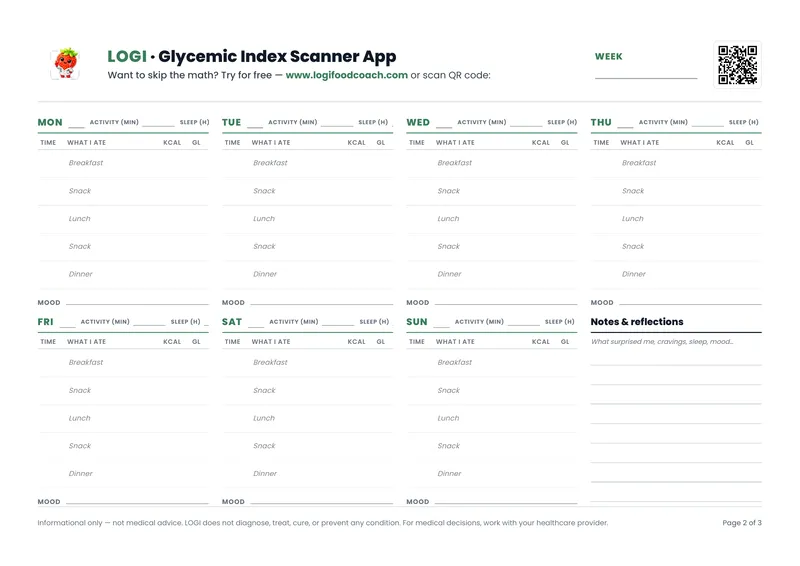
Free PDF — 3 pages
Your Weekly Food Journal
Track meals, glycemic load & mood. Spot patterns in 3 weeks.
No spam. Unsubscribe anytime.