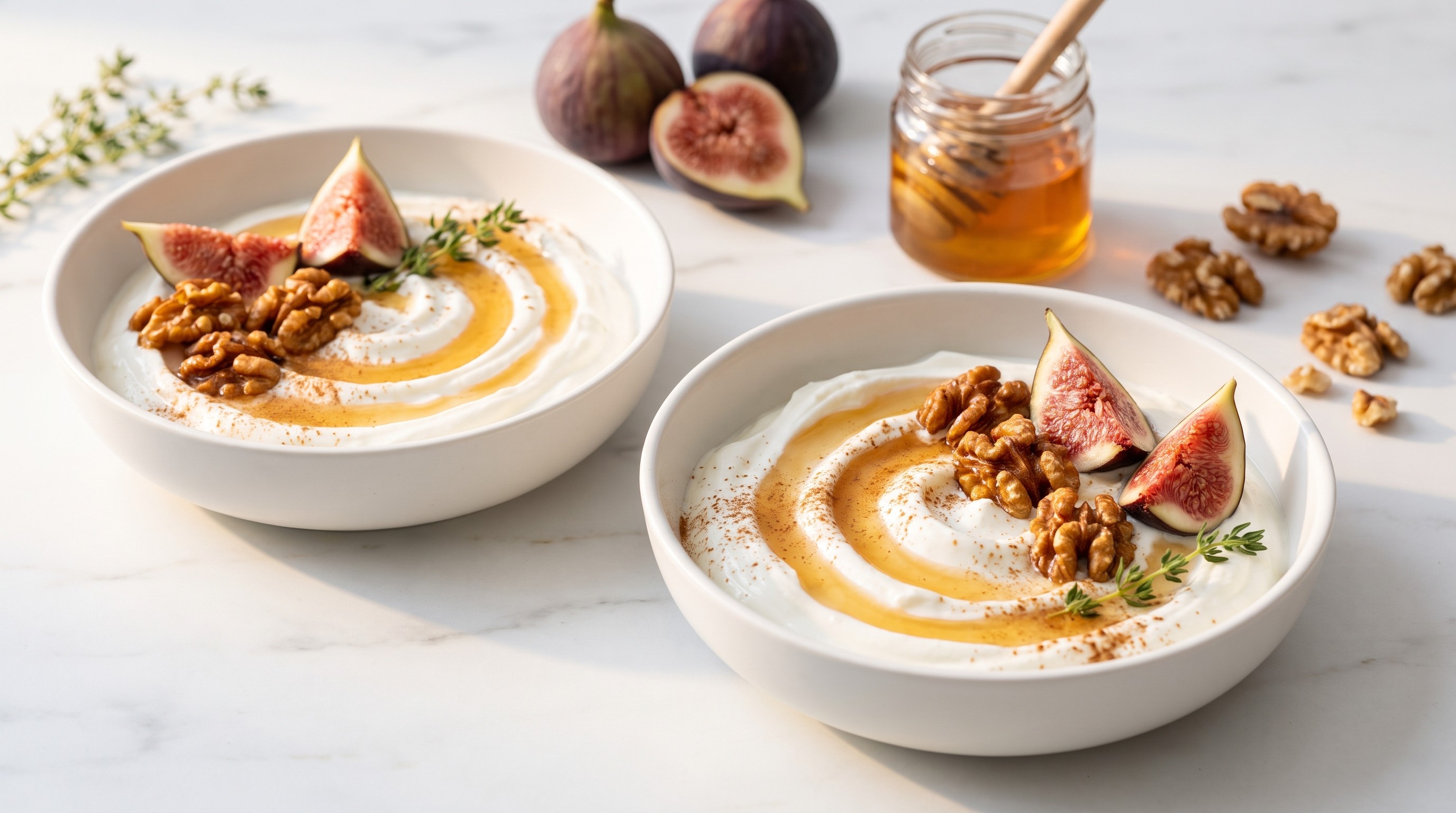
Greek Yogurt with Honey and Roasted Walnuts
Creamy full-fat Greek yogurt topped with toasted walnuts, fresh figs, and a delicate drizzle of honey — a protein-rich bowl that keeps blood sugar steady for hours.
This classic Greek taverna dessert proves that blood-sugar-friendly eating can be genuinely indulgent. A generous bed of thick, full-fat straggisto yogurt delivers roughly 20 grams of protein per bowl, creating a slow-digesting base that blunts the glycemic impact of everything layered on top. The high fat content further slows gastric emptying, giving your body time to process sugars gradually rather than in a sharp spike.
Honey is the ingredient most people worry about, but context matters. A single teaspoon per serving — just 7 grams — sits on top of a protein-and-fat matrix that dramatically lowers its effective glycemic load. Paired with walnuts, which contribute heart-healthy omega-3 fatty acids and additional protein, the overall meal lands firmly in low-glycemic territory. Cinnamon is more than a flavoring here: research suggests it may improve insulin sensitivity and slow carbohydrate digestion, making it a strategic finishing touch.
Fresh figs add natural sweetness and a beautiful presentation. While figs carry a medium glycemic index on their own, the small portion used here — combined with the fat and protein surrounding them — keeps the glycemic load minimal. For the best blood sugar response, eat a few bites of the plain yogurt and walnuts first before reaching for the honey-drizzled sections. This simple sequencing trick lets protein and fat reach your stomach ahead of any sugars, flattening the glucose curve even further.
Blood Sugar Impact
Low impact expected — the combination of protein-rich Greek yogurt, healthy fats from walnuts, and fiber from figs significantly buffers the small amount of honey, resulting in a gentle, slow rise in blood sugar with stable energy for 3-4 hours. The estimated GI of 34 and glycemic load of 8.4 both fall well within the low range.
Blood Sugar Tips
- ✓ Eat the walnuts and fig first before mixing in the honey, as the fiber and fat will slow gastric emptying and blunt the sugar response from the honey.
- ✓ Use the honey drizzled on top rather than stirred in — smaller, undiluted taste hits feel sweeter, so you can gradually reduce the amount without missing it.
- ✓ Add a pinch more cinnamon — Ceylon cinnamon has been shown to improve insulin sensitivity and can help moderate post-meal glucose by 10-15%.
🥗 Ingredients
- 400 g Greek yogurt
- 60 g Walnut
- 2 pcs Fig
- 2 tsp Honey
- 0.25 tsp Cinnamon
- 14.1 oz Greek yogurt
- 2.1 oz Walnut
- 2 pcs Fig
- 2 tsp Honey
- 0.25 tsp Cinnamon
👨🍳 Instructions
- 1
Place the walnut halves in a dry skillet set over medium heat. Toast them for 3 to 4 minutes, shaking the pan every 30 seconds or so, until they smell nutty and the edges turn light golden. Watch closely as they can burn quickly.
- 2
Transfer the toasted walnuts to a plate and spread them in a single layer so they stop cooking. Let them cool for a minute or two while you prepare the rest of the bowl.
- 3
Rinse the fresh figs gently under cool water and pat them dry. Trim the stems, then slice each fig lengthwise into quarters.
- 4
Divide the yogurt evenly between two shallow serving bowls. Use the back of a spoon to spread it into a thick, smooth layer that reaches close to the rim, creating a wide canvas for the toppings.
- 5
Arrange the fig quarters around the edge of each bowl, leaning them gently against the yogurt so they fan outward. This places the fruit at the perimeter, encouraging you to eat the protein-rich center first.
- 6
Break the toasted walnuts into rough, uneven pieces and scatter them generously across the surface of the yogurt in each bowl, concentrating them toward the center.
- 7
Drizzle exactly one teaspoon of honey over each bowl in a slow, thin stream, letting it fall in natural ribbons across the yogurt and walnuts. Resist the urge to add more — the fat and protein base will amplify the sweetness.
- 8
Finish each bowl with a light pinch of ground cinnamon dusted evenly over the top. Serve immediately while the walnuts still carry residual warmth for the best contrast of cool yogurt and toasty nuts.
📊 Nutrition Per Serving
| Per Serving | Whole Dish | |
|---|---|---|
| Calories | 366 | 732 |
| Carbs | 25g | 50g |
| Sugars | 19g | 39g |
| Natural Sugars | 19g | 39g |
| Protein | 25g | 50g |
| Fat | 20g | 41g |
| Saturated Fat | 2g | 4g |
| Unsaturated Fat | 18g | 35g |
| Fiber | 3g | 7g |
| Soluble Fiber | 1g | 2g |
| Insoluble Fiber | 2g | 5g |
| Sodium | 73mg | 147mg |
Predicted Glucose Response
What if you...
Estimated model — individual responses vary. Not medical advice.
🔄 Lower GI Swaps
Honey has a moderate-to-high GI (around 58–65) and is the primary driver of this recipe's glycemic load. Allulose (GI ≈ 0), yacon syrup (GI ≈ 1), and monk fruit sweetener (GI 0) deliver sweetness with virtually no blood sugar impact, significantly lowering the overall GL.
Figs (especially dried) have a moderate-to-high GI (51–61) and notable sugar content. Raspberries (GI ≈ 25), blackberries (GI ≈ 25), and strawberries (GI ≈ 25) are among the lowest-GI fruits available, rich in fiber that further slows glucose absorption, and substantially reduce the recipe's glycemic load.
Walnuts are already low-GI, but almonds (GI ≈ 0–15) and macadamia nuts (GI ≈ 0–10) have slightly higher monounsaturated fat and fiber content per serving, which can further blunt the postprandial glucose response when eaten alongside higher-GI components. This is a minor optimization rather than a critical swap.
Standard Greek yogurt is already low-GI (≈ 11), but skyr and extra-strained high-protein varieties have even higher protein density per serving. The additional protein slows gastric emptying and reduces the overall glycemic response of the meal, helping keep the GL as low as possible.
🔬 The Science Behind This Recipe
Here's the science explainer section:
---
Why This Recipe Works for Your Blood Sugar
This bowl might look like a simple breakfast, but there's a smart balancing act happening between its ingredients. Greek yogurt is the star here — it's packed with protein (around 15–20 grams per serving), which slows down the rate at which your body breaks down and absorbs sugars. When you eat protein alongside carbohydrates like honey or figs, it acts like a speed bump for digestion, giving your blood sugar a gentler, more gradual rise instead of a sharp spike. The result is steadier energy and fewer of those mid-morning crashes.
Walnuts add another layer of protection. Their combination of healthy fats and fiber further slows gastric emptying — the speed at which food leaves your stomach. Think of it this way: honey on its own would hit your bloodstream relatively quickly, but when it's wrapped in a meal containing fat, protein, and fiber, your body processes it much more slowly. This is why the glycemic load of this recipe sits at just 8.4, which is considered low. And here's an important concept: glycemic load accounts for how *much* sugar you're actually eating, not just how fast it hits. A drizzle of honey has a high glycemic index on its own, but the small amount used here — combined with all that protein and fat — keeps the real-world impact minimal.
Want to maximize the benefits? Try eating the yogurt and walnuts first before drizzling the honey and adding the figs. This "vegetables and protein first" strategy has been shown to reduce post-meal glucose spikes by up to 30–40%. A short 10–15 minute walk after eating can help even further, as your muscles pull sugar directly from your bloodstream for energy. Cinnamon is more than a flavor addition too — research suggests it may help improve your body's sensitivity to insulin, the hormone responsible for clearing sugar from your blood. Small choices, big impact.
---
That comes in at ~290 words. It covers the three key ingredients (Greek yogurt, walnuts, honey/figs), explains glycemic load vs. GI, and includes practical tips (food order, walking, pairing strategies) — all in an accessible, empowering tone without medical claims or jargon.
Related recipes

Free PDF — 3 pages
Your Weekly Food Journal
Track meals, glycemic load & mood. Spot patterns in 3 weeks.
No spam. Unsubscribe anytime.
