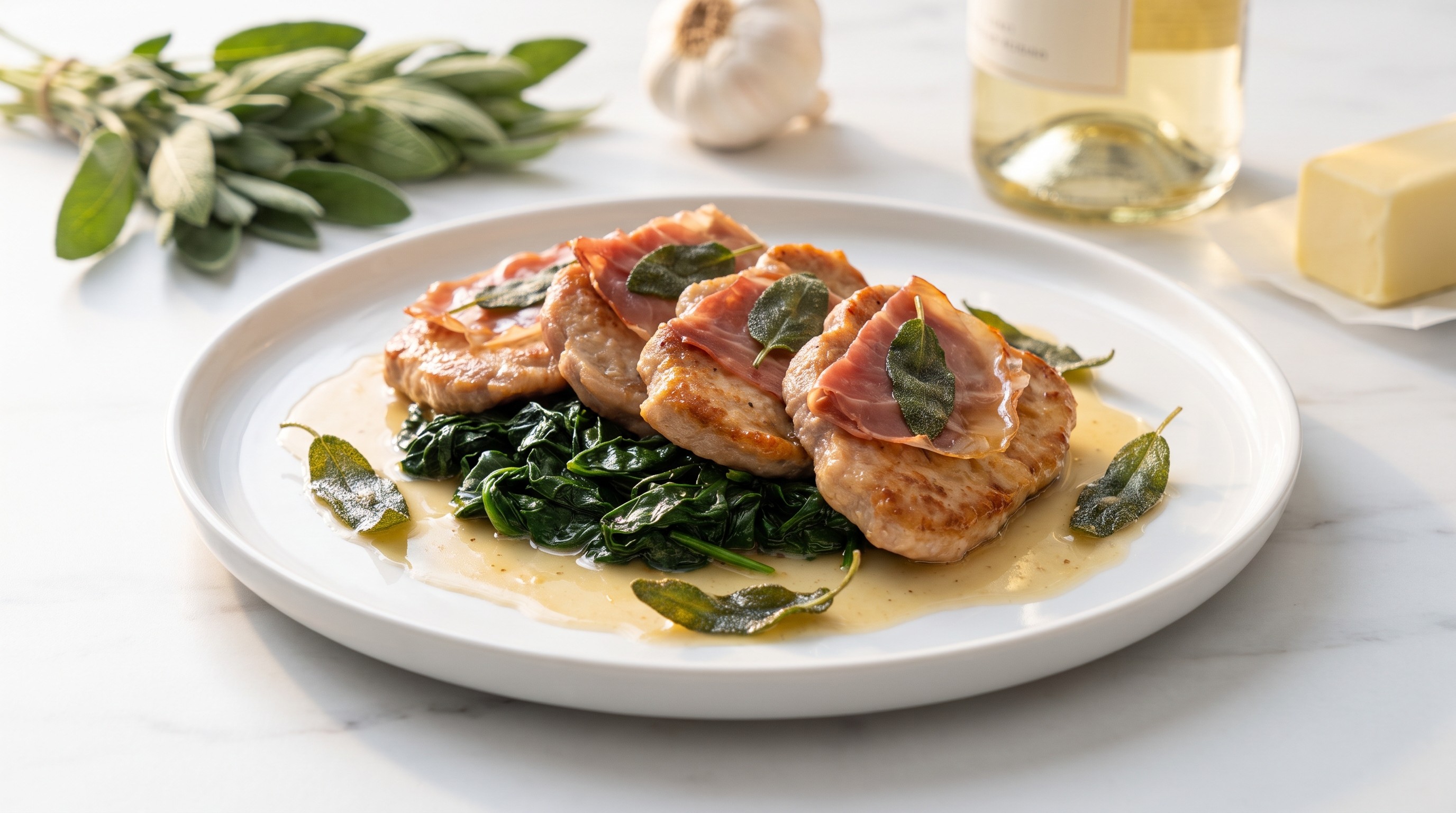
Saltimbocca alla Romana with Garlicky Wilted Spinach
Prosciutto-wrapped veal escalopes with sage, finished in a white wine pan sauce over garlicky spinach — virtually zero-carb and ideal for steady blood sugar.
Saltimbocca alla Romana is one of those rare Italian classics that needs no low-glycemic adaptation at all. Built entirely from protein and fat — thin veal escalopes pinned with salty prosciutto and aromatic sage, then pan-fried in butter and olive oil — the dish delivers deep, savoury satisfaction without a single blood-sugar spike. The quick white wine pan sauce adds brightness while the alcohol cooks off, leaving behind concentrated flavour with negligible residual sugar.
Serving the saltimbocca over a generous bed of garlicky wilted baby spinach is more than a presentation choice — it is a metabolic strategy. Spinach is extraordinarily low on the glycemic index, rich in magnesium (which supports insulin sensitivity), and packed with fibre that further blunts any glucose response from the trace carbohydrates in the wine and garlic. Eating the greens first, before cutting into the veal, primes your digestive system with fibre and slows gastric emptying.
This is a restaurant-worthy plate that comes together in twenty minutes, making it a perfect weeknight dinner for anyone managing blood sugar. Pair it with a small side of cooled and reheated lentils or a few roasted cauliflower florets if you want extra volume, and you have a complete, deeply satisfying meal that keeps your glucose curve flat from first bite to last.
Blood Sugar Impact
Very minimal blood sugar impact expected. With a glycemic load of just 1.8 and an estimated GI of 19, this protein-and-fat-rich dish contains virtually no carbohydrates, resulting in stable blood sugar and sustained energy for 3-4 hours.
Blood Sugar Tips
- ✓ Eat the garlicky spinach first before the veal — the fiber and volume will further slow any minimal glucose absorption.
- ✓ Avoid adding a high-GI side like white bread or mashed potatoes; if you want a starch, choose a small portion of al dente whole-grain pasta or roasted sweet potato.
- ✓ Take a gentle 10-15 minute walk after the meal to enhance insulin sensitivity and keep blood sugar completely flat.
🥗 Ingredients
- 4 pcs Veal escalope
- 4 pcs Prosciutto crudo
- 8 pcs Sage leaf
- 30 g Unsalted butter
- 1 tbsp Olive oil
- 100 ml Dry white wine
- 300 g Baby spinach
- 1 pcs Garlic clove
- 1 tsp Salt
- 0.25 tsp Black pepper
- 0.5 pcs Lemon
- 4 pcs Veal escalope
- 4 pcs Prosciutto crudo
- 8 pcs Sage leaf
- 1.1 oz Unsalted butter
- 1 tbsp Olive oil
- 7 tbsp Dry white wine
- 10.6 oz Baby spinach
- 1 pcs Garlic clove
- 1 tsp Salt
- 0.25 tsp Black pepper
- 0.5 pcs Lemon
👨🍳 Instructions
- 1
Sandwich each veal escalope between two sheets of cling film and gently pound them with a rolling pin or the flat base of a heavy pan until they are an even 5 mm thick. Season both sides lightly with salt and freshly ground black pepper.
- 2
Place one fresh sage leaf in the centre of each escalope. Lay a slice of prosciutto crudo over the sage so it covers most of the surface, then press down firmly with your palm — the natural moisture of the veal will make the prosciutto stick without the need for toothpicks or skewers.
- 3
Set a large skillet over high heat and add the olive oil along with half the butter (about 15 g). Let the butter melt and foam, then wait for the foaming to die down — this signals the pan is hot enough. Lay the escalopes in the skillet prosciutto-side down.
- 4
Cook undisturbed for about 2 minutes until the prosciutto turns crisp and golden. Flip each escalope and sear the veal side for 1 minute more. Transfer the escalopes to a warm plate, prosciutto-side up, and loosely tent with foil.
- 5
Drop the remaining 4 sage leaves into the hot skillet. Fry for roughly 30 seconds, turning once, until they are crisp and deep green. Lift them out with a fork and set aside for garnish.
- 6
With the skillet still on the heat, pour in the dry white wine. Use a wooden spoon to scrape up every bit of caramelised fond from the bottom of the pan. Let the wine bubble and reduce by about half — this takes around 1 minute. Remove the skillet from the heat, add the remaining butter, and swirl the pan continuously until the sauce is glossy and emulsified. Squeeze in the juice of half a lemon and stir through.
- 7
While the sauce reduces, heat a second pan over medium heat. Add the crushed garlic clove and the baby spinach. Toss constantly for about 2 minutes until the spinach has just wilted and collapsed but still holds its bright green colour. Season with a pinch of salt.
- 8
Divide the garlicky spinach between two warmed plates, forming a loose bed in the centre. Arrange two escalopes on each plate, spoon the wine and butter pan sauce generously over the top, and finish with the fried sage leaves. Serve immediately — start with a few bites of the spinach before the veal to get fibre into your system first for a gentler glucose response.
📊 Nutrition Per Serving
| Per Serving | Whole Dish | |
|---|---|---|
| Calories | 653 | 1306 |
| Carbs | 10g | 19g |
| Sugars | 1g | 3g |
| Natural Sugars | 1g | 3g |
| Protein | 68g | 136g |
| Fat | 35g | 69g |
| Saturated Fat | 14g | 28g |
| Unsaturated Fat | 19g | 38g |
| Fiber | 4g | 9g |
| Soluble Fiber | 1g | 3g |
| Insoluble Fiber | 3g | 6g |
| Sodium | 2110mg | 4221mg |
Predicted Glucose Response
What if you...
Estimated model — individual responses vary. Not medical advice.
🔄 Lower GI Swaps
White wine contains residual sugars that contribute to glycemic load. Bone broth adds savory depth with virtually zero glycemic impact, dry vermouth delivers similar flavor with less residual sugar per volume, and diluted lemon juice keeps the acidity for deglazing without any sugar contribution.
While butter has a negligible GI, extra virgin olive oil contains oleocanthal and polyphenols shown to improve insulin sensitivity and reduce post-meal blood sugar spikes. Avocado oil offers similar benefits with a high smoke point suitable for pan-frying. These swaps support better overall glycemic response without changing the GL significantly.
While baby spinach is already low-GI, mature kale and Swiss chard provide significantly more fiber per serving, which further slows glucose absorption. Kale also contains more chromium, a mineral that supports insulin function. Broccoli rabe adds sulforaphane, which research links to improved blood sugar regulation.
🔬 The Science Behind This Recipe
Why This Recipe Works for Your Blood Sugar
This Saltimbocca alla Romana is a naturally blood-sugar-friendly meal, and the reason comes down to what's on the plate — and what isn't. With a glycemic load of just 1.8 per serving and an estimated GI of 19, this dish barely nudges your blood sugar at all. That's because it's built almost entirely on protein and healthy fats, the two macronutrients that have the least impact on glucose levels. Veal escalope delivers a generous dose of complete protein, which your body digests slowly and steadily without triggering the sharp insulin response that refined carbohydrates do. Meanwhile, the butter and olive oil provide quality fats that act as a natural brake on digestion, keeping everything moving through your system at a gentle, even pace.
The garlicky wilted spinach is the unsung hero here. Leafy greens like spinach are rich in fiber and magnesium — both of which play a role in how your body handles glucose. Fiber slows the absorption of any sugars present in the meal, while magnesium supports healthy insulin sensitivity. If you're serving this alongside a starch like potatoes or bread, eat the spinach and veal first. Research suggests that eating vegetables and protein before carbohydrates can reduce post-meal glucose spikes by up to 30-40%, simply by changing the order food arrives in your stomach.
Remember that glycemic load matters more than glycemic index alone — it accounts for how much carbohydrate you're actually eating, not just how fast it hits your bloodstream. A dish like this, with almost no carbohydrate content, keeps your glycemic load remarkably low. For an extra edge, a short 10-15 minute walk after eating helps your muscles absorb glucose directly, smoothing out any remaining rise. Pairing protein-rich main courses like Saltimbocca with fiber-packed vegetables is one of the simplest, most effective strategies for keeping your energy steady long after the meal is over.
Related recipes
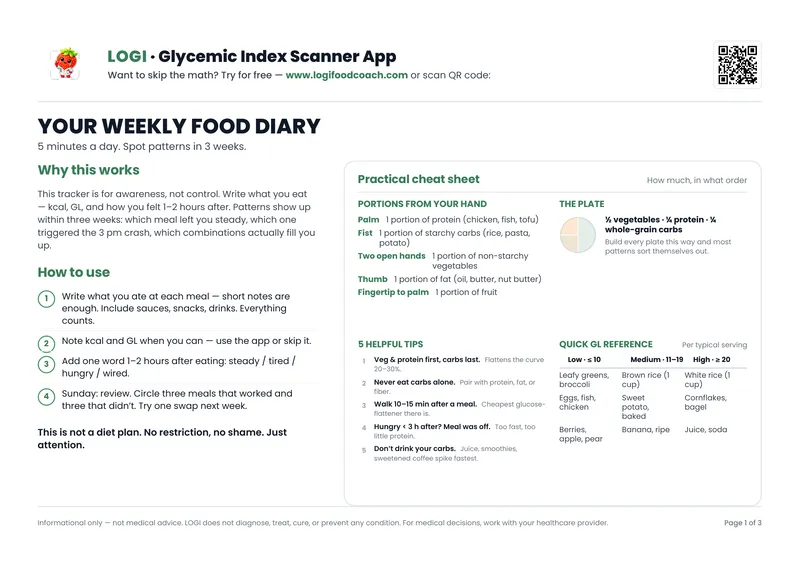
Free PDF — 3 pages
Your Weekly Food Journal
Track meals, glycemic load & mood. Spot patterns in 3 weeks.
No spam. Unsubscribe anytime.