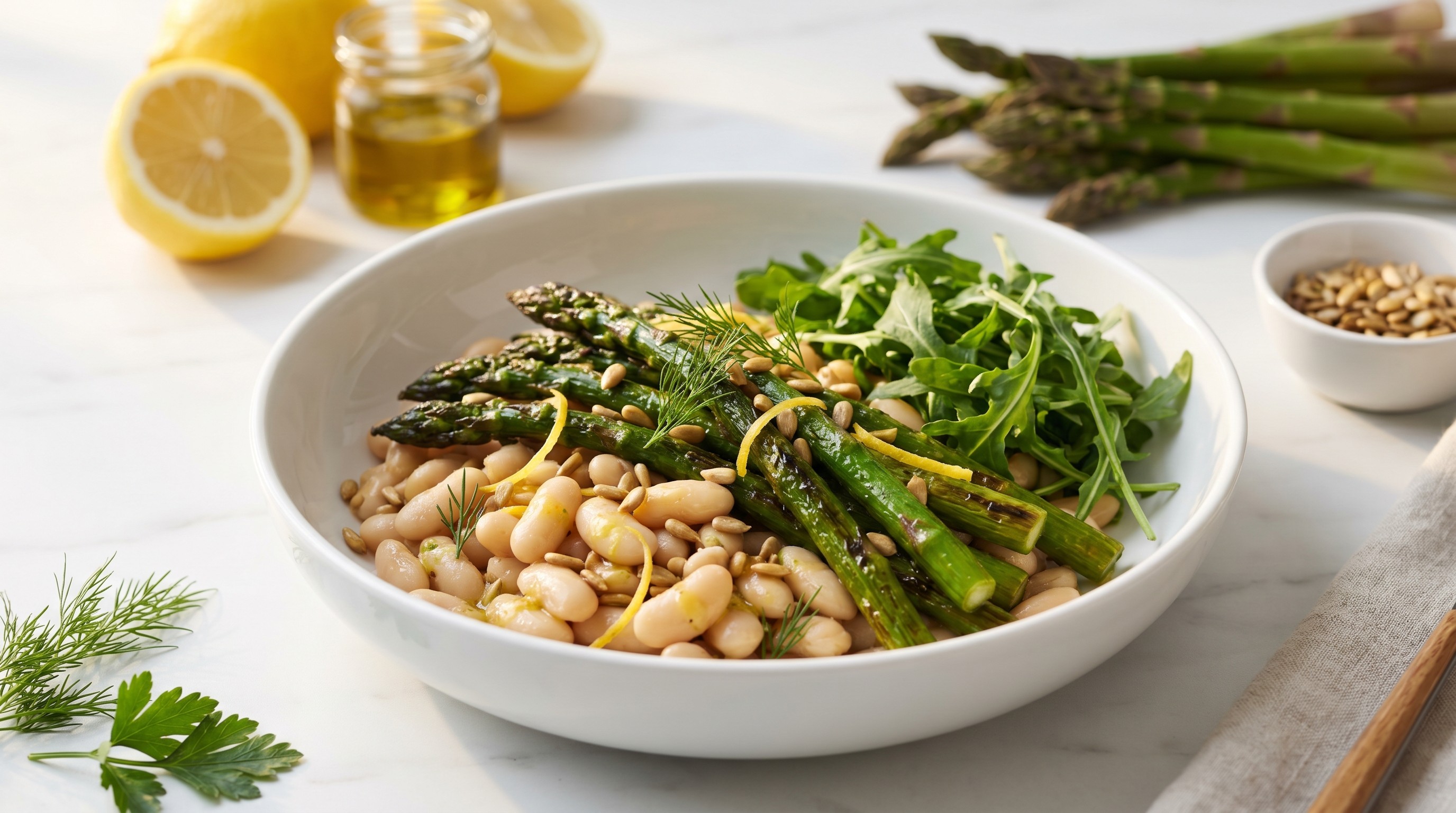
Roasted Asparagus and White Bean Salad with Lemon Vinaigrette
Charred asparagus and fiber-rich cannellini beans in a bright lemon vinaigrette — a low-GI salad that keeps blood sugar steady and hunger at bay.
This warm salad is a textbook example of how to build a blood-sugar-friendly meal without sacrificing flavor. Cannellini beans anchor the dish with slow-digesting complex carbohydrates and resistant starch — a type of fiber that feeds beneficial gut bacteria and blunts postprandial glucose spikes. Combined with the soluble fiber in roasted asparagus and the healthy fats from olive oil and sunflower seeds, every component works to slow carbohydrate absorption and extend satiety.
The technique matters as much as the ingredients. Roasting asparagus at high heat caramelizes its natural sugars without adding any, producing deep savory notes and a slight char that plays beautifully against the creamy, mild beans. A sharp lemon-Dijon vinaigrette cuts through the richness and ties the plate together. Peppery rocket adds a fresh, bitter counterpoint that rounds out the flavor profile.
From a glycemic perspective, this salad delivers over nine grams of fiber per serving while keeping the overall glycemic load remarkably low. The combination of protein from the beans, fat from the olive oil and seeds, and fiber from every element means glucose enters the bloodstream gradually rather than in a sharp spike. For optimal blood sugar response, eat the rocket and asparagus first, then move to the beans — consuming vegetables before starches has been shown to reduce postmeal glucose by up to 30 percent. This dish works beautifully as a standalone lunch or as a generous side alongside grilled fish or chicken.
Blood Sugar Impact
Very low blood sugar impact expected. The combination of high-fiber cannellini beans, non-starchy vegetables, and healthy fats from olive oil and sunflower seeds will promote stable blood glucose with minimal postprandial rise.
Blood Sugar Tips
- ✓ Start with the arugula and asparagus before eating the beans to further blunt any glucose response with fiber and volume.
- ✓ Include the full portion of sunflower seeds and olive oil — the healthy fats slow gastric emptying and reduce the glycemic response of the beans.
- ✓ A short 10-15 minute walk after eating can enhance glucose uptake by muscles and keep levels even flatter.
🥗 Ingredients
- 300 g Asparagus
- 400 g Cannellini bean
- 2 tbsp Olive oil
- 30 g Sunflower seed
- 40 g Rocket
- 1 pcs Lemon zest
- 3 tbsp Extra-virgin olive oil
- 2 tbsp Lemon juice
- 1 tsp Dijon mustard
- 1 pcs Garlic
- 1 tsp Salt
- 10.6 oz Asparagus
- 8.5 oz Cannellini bean
- 2 tbsp Olive oil
- 1.1 oz Sunflower seed
- 1.4 oz Rocket
- 1 pcs Lemon zest
- 3 tbsp Extra-virgin olive oil
- 2 tbsp Lemon juice
- 1 tsp Dijon mustard
- 1 pcs Garlic
- 1 tsp Salt
👨🍳 Instructions
- 1
Heat the oven to 220°C (425°F). Snap the tough, woody ends from the asparagus spears — they break naturally at the right point. Place the trimmed spears on a rimmed baking tray.
- 2
Drizzle the asparagus with 2 tablespoons of olive oil, season with a good pinch of salt, and roll the spears to coat evenly. Spread them out in a single layer so they roast rather than steam.
- 3
Slide the tray into the oven and roast for 12 to 14 minutes. Flip the spears once at the halfway mark. They are done when tender through the middle with lightly blistered, charred tips. Pull the tray out and let the asparagus rest for a couple of minutes.
- 4
While the asparagus is in the oven, scatter the sunflower seeds into a dry skillet set over medium heat. Stir them continuously for 3 to 4 minutes until they turn golden and smell nutty. Transfer immediately to a plate so they do not burn from residual heat.
- 5
Prepare the vinaigrette by combining the extra-virgin olive oil, lemon juice, Dijon mustard, and minced garlic in a small bowl. Whisk briskly until the mixture emulsifies into a creamy, unified dressing. Season with salt and pepper — it should taste assertively lemony and sharp.
- 6
Drain and rinse the cannellini beans, then tip them into a mixing bowl. Spoon roughly half the vinaigrette over the beans and fold gently to coat without crushing them. Taste and adjust seasoning. The acid from the lemon juice helps lower the overall glycemic response of the beans.
- 7
Arrange the dressed beans across a serving plate or shallow bowl. Lay the roasted asparagus over the top. Tuck the rocket alongside or scatter it around the edges — eating the greens first before the beans can help moderate the blood sugar response.
- 8
Finish by scattering the toasted sunflower seeds and lemon zest over everything. Drizzle the remaining vinaigrette across the plate. Serve while the asparagus is still warm — the contrast of warm spears, room-temperature beans, and cool peppery rocket is part of the appeal.
📊 Nutrition Per Serving
| Per Serving | Whole Dish | |
|---|---|---|
| Calories | 524 | 1048 |
| Carbs | 28g | 56g |
| Sugars | 5g | 9g |
| Added Sugars | 0g | 0g |
| Natural Sugars | 5g | 9g |
| Protein | 14g | 28g |
| Fat | 43g | 85g |
| Saturated Fat | 6g | 11g |
| Unsaturated Fat | 37g | 74g |
| Fiber | 12g | 23g |
| Soluble Fiber | 1g | 2g |
| Insoluble Fiber | 3g | 5g |
| Sodium | 1214mg | 2428mg |
Predicted Glucose Response
What if you...
Estimated model — individual responses vary. Not medical advice.
🔄 Lower GI Swaps
Cannellini beans have a moderate GI (~31-40). Black soybeans (GI ~16) and lupini beans (GI ~15) are among the lowest-GI legumes, significantly reducing the glycemic load of the dish. French green lentils (GI ~22) also offer a lower glycemic impact while maintaining a similar texture.
Some commercial Dijon mustards contain added sugars or honey that can slightly raise glycemic impact. Whole grain and stone-ground mustards typically have no added sugars and contain intact mustard seeds, which contribute fiber and have virtually no effect on blood sugar.
While lemon juice itself is low-GI, adding vinegar (acetic acid) to a meal has been shown in studies to reduce the postprandial glycemic response by 20-30%. Using vinegar alongside or in place of some lemon juice enhances the blood-sugar-lowering effect of the vinaigrette.
Sunflower seeds are already low-GI, but almonds (GI ~0, rich in monounsaturated fat) and walnuts (GI ~0, high in omega-3s) have been shown to further blunt postprandial glucose spikes when added to meals. Hemp seeds provide additional protein and healthy fats with virtually zero glycemic impact.
🔬 The Science Behind This Recipe
Here's the science explainer for this recipe:
---
Why This Recipe Works for Your Blood Sugar
This salad is a textbook example of how smart ingredient pairing keeps your blood sugar steady. Cannellini beans are the star here — they're packed with both soluble fiber and plant-based protein, which work together to slow down how quickly your body converts food into glucose. Think of fiber as a speed bump on the road to your bloodstream: it forces sugars to absorb gradually rather than flooding in all at once. With a estimated glycemic index of just 26, this dish sits firmly in the "low" category, meaning it produces a gentle, sustained rise in energy rather than the sharp spike-and-crash cycle that leaves you reaching for snacks an hour later.
The olive oil and sunflower seeds add healthy fats to the equation, and here's why that matters: fat slows gastric emptying, which is a fancy way of saying your stomach takes longer to pass food along for digestion. This gives your body more time to process glucose at a manageable pace. Meanwhile, asparagus and arugula contribute additional fiber with virtually no sugar, effectively diluting the glycemic impact of the entire meal. It's worth understanding the concept of glycemic load here — this dish scores just 7.2 per serving, which is considered low. While glycemic index tells you how fast a food raises blood sugar, glycemic load accounts for how much carbohydrate you're actually eating. A small amount of a moderate-GI food can still be perfectly blood-sugar-friendly, and that's exactly what's happening with the beans in this recipe.
To get the most out of this meal, try eating the asparagus and arugula first before moving on to the beans — research suggests that eating vegetables before carbohydrates can reduce post-meal glucose spikes. A short 10-to-15-minute walk after eating can also help your muscles soak up circulating glucose more efficiently. These small habits, paired with already well-balanced recipes like this one, add up to meaningful support for your metabolic health over time.
Related recipes

Free PDF — 3 pages
Your Weekly Food Journal
Track meals, glycemic load & mood. Spot patterns in 3 weeks.
No spam. Unsubscribe anytime.
