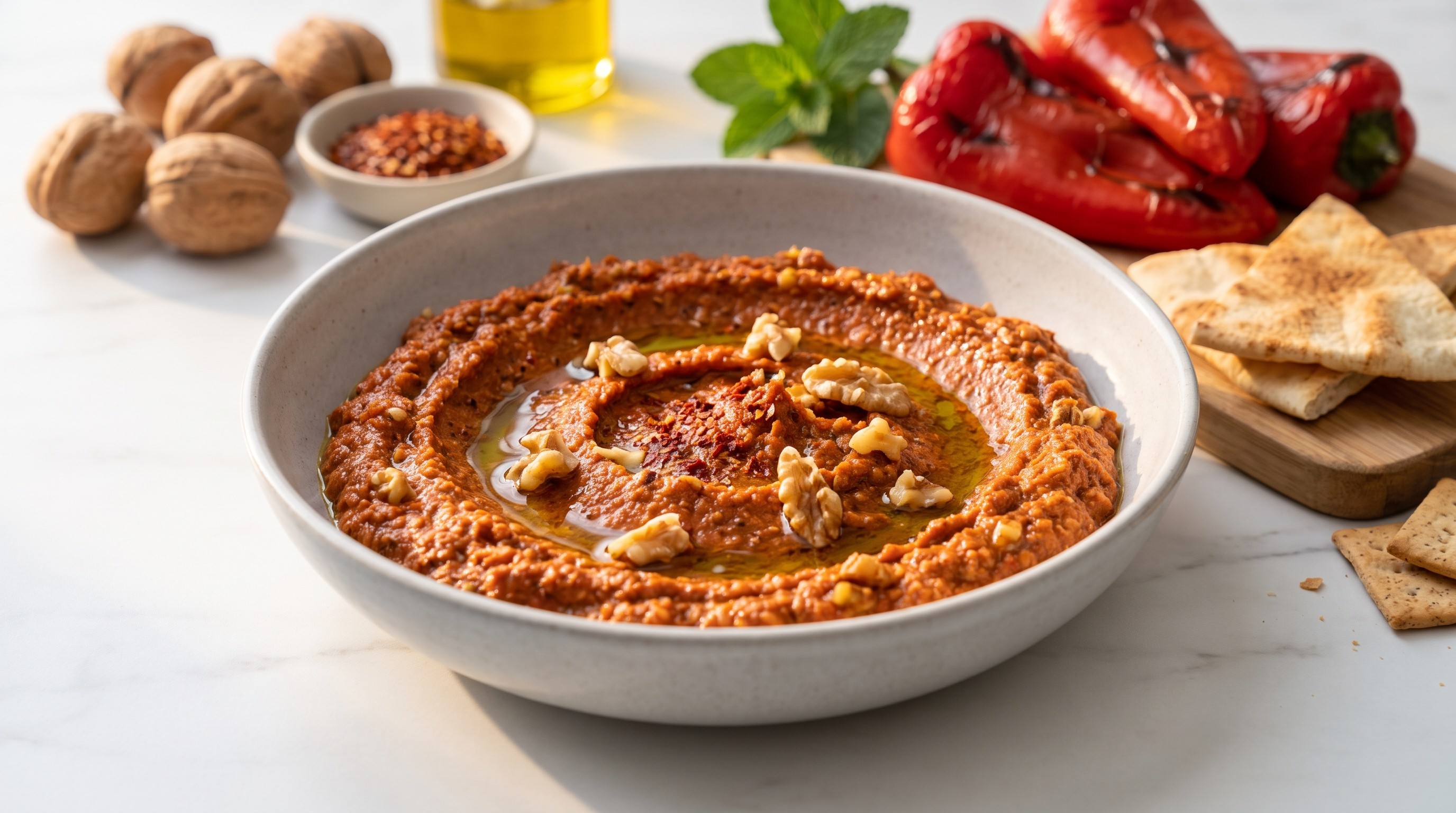
Muhammara (Roasted Red Pepper & Walnut Dip)
A smoky Syrian dip of roasted red peppers and toasted walnuts — packed with healthy fats and fiber, virtually no starch, and a gentle glycemic footprint.
Muhammara is one of the most naturally blood-sugar-friendly dips you can make. Built on a foundation of roasted red peppers and walnuts, it delivers satisfying richness almost entirely from heart-healthy fats and dietary fiber rather than starch or sugar. The walnuts supply alpha-linolenic acid (an omega-3 fatty acid) that research links to improved insulin sensitivity, while the peppers contribute vitamin C and antioxidants with a very low glycemic index of around 15.
The only ingredient worth watching is pomegranate molasses, a concentrated fruit syrup that can carry a moderate glycemic load in larger quantities. Here it appears in a restrained two-teaspoon measure — just enough to lend the characteristic sweet-tart backbone without delivering meaningful sugar per serving. A generous drizzle of extra-virgin olive oil rounds out the fat profile and further slows glucose absorption from any trace carbohydrates present.
For the best glycemic outcome, serve muhammara alongside raw vegetable crudités — cucumber rounds, celery sticks, or endive leaves — rather than pita or crackers. Eating the vegetables first creates a fiber buffer that blunts any postprandial glucose rise. This dip also pairs beautifully as a condiment alongside grilled chicken or fish, turning a simple protein into a complete, satisfying meal that keeps blood sugar steady for hours.
Blood Sugar Impact
Very low blood sugar impact expected. The combination of healthy fats from walnuts and olive oil, fiber from roasted peppers, and protein creates a slow, minimal glucose response with stable energy for 3-4 hours.
Blood Sugar Tips
- ✓ Pair with raw vegetable crudités (cucumber, celery, bell pepper strips) to add fiber and further slow any glucose absorption.
- ✓ Use as a spread on whole-grain or seed-based crackers rather than white bread or pita to keep the overall glycemic load of the meal low.
- ✓ Enjoy muhammara at the start of a meal as an appetizer — the fats and fiber will blunt the glucose spike from any higher-GI foods eaten afterward.
🥗 Ingredients
- 200 g Roasted red pepper
- 80 g Walnut
- 2 tbsp Extra virgin olive oil
- 2 tsp Pomegranate molasses
- 1 pcs Garlic
- 1 tsp Ground cumin
- 1 tsp Aleppo pepper flakes
- 0.5 tsp Salt
- 7.1 oz Roasted red pepper
- 2.8 oz Walnut
- 2 tbsp Extra virgin olive oil
- 2 tsp Pomegranate molasses
- 1 pcs Garlic
- 1 tsp Ground cumin
- 1 tsp Aleppo pepper flakes
- 0.5 tsp Salt
👨🍳 Instructions
- 1
Pick out a small handful of walnut halves and set them aside — these will be scattered over the finished dip as a garnish.
- 2
Place the remaining walnuts in a dry frying pan over medium heat. Toast them for about 3 minutes, shaking the pan every 30 seconds or so, until they smell fragrant and have turned lightly golden. Slide them off the heat and onto a plate to cool briefly.
- 3
Drain the jarred roasted red peppers thoroughly, then lay them flat between two layers of paper towels and press down firmly to squeeze out as much moisture as possible. Removing this liquid prevents the dip from turning watery.
- 4
Add the pressed peppers, toasted walnuts, garlic clove, ground cumin, Aleppo pepper flakes, pomegranate molasses, and salt to the bowl of a food processor.
- 5
Pulse the mixture in short bursts — roughly 15 to 20 times — until you have a coarse, textured paste. Check the consistency after every few pulses and stop well before the mixture becomes smooth; muhammara should have visible bits of walnut and pepper running through it.
- 6
With the processor running on low, pour in half of the olive oil in a thin stream and let it blend for about 5 seconds until just incorporated. Turn off the machine immediately to keep the rustic texture intact.
- 7
Scrape the muhammara into a shallow serving bowl using a spatula, spreading it into an even layer with a slight well in the centre.
- 8
Drizzle the remaining olive oil over the surface, then scatter the reserved walnut pieces and a final pinch of Aleppo pepper flakes on top. Serve at room temperature alongside raw vegetable crudités such as cucumber, celery, or endive for the best blood-sugar response.
📊 Nutrition Per Serving
| Per Serving | Whole Dish | |
|---|---|---|
| Calories | 437 | 874 |
| Carbs | 18g | 35g |
| Sugars | 10g | 19g |
| Natural Sugars | 10g | 19g |
| Protein | 7g | 15g |
| Fat | 40g | 80g |
| Saturated Fat | 4g | 9g |
| Unsaturated Fat | 35g | 70g |
| Fiber | 6g | 12g |
| Soluble Fiber | 2g | 4g |
| Insoluble Fiber | 4g | 8g |
| Sodium | 587mg | 1175mg |
Predicted Glucose Response
What if you...
Estimated model — individual responses vary. Not medical advice.
🔄 Lower GI Swaps
Pomegranate molasses is the highest glycemic ingredient in this recipe, as it is essentially concentrated fruit sugars (GI ~55-65). Replacing it with lemon juice and sumac delivers the same tart, tangy depth with virtually zero glycemic impact. Apple cider vinegar has been shown to help moderate postprandial blood sugar responses, and tamarind paste provides sourness at a fraction of the sugar content.
Red bell peppers have a low but measurable GI (~40) and contain natural sugars that contribute to the recipe's glycemic load. Partially replacing them with roasted eggplant (GI ~15) or roasted zucchini (GI ~15) lowers the total carbohydrate and sugar content of the dip while maintaining a creamy, smoky base. A 50/50 blend preserves the signature color and flavor while meaningfully reducing glycemic load.
Walnuts are already low-GI, but almonds have slightly more fiber and protein per gram, which further slows glucose absorption. Hemp seeds add extra protein and healthy fats with virtually no carbohydrates (GI near 0). Pecans are among the lowest-carb tree nuts. Any of these choices marginally improve the fat-to-carb ratio, helping blunt any residual blood sugar response from other ingredients.
🔬 The Science Behind This Recipe
Here's the science explainer section for the Muhammara recipe:
---
Why This Dip Loves Your Blood Sugar
Muhammara is a beautiful example of how traditional recipes can naturally support steady blood sugar. With a glycemic load of just 4.5 per serving and an estimated GI of 25, this dip sits comfortably in the "low" category for both measures. But what makes it so gentle on your glucose? It comes down to the starring trio: walnuts, extra virgin olive oil, and roasted red peppers. Walnuts are rich in healthy fats and plant-based protein, both of which slow down the rate at which your body absorbs sugars from food. Think of them as a natural speed bump for glucose entering your bloodstream. Extra virgin olive oil works similarly — its monounsaturated fats create a buffer that helps prevent the sharp rises and crashes many people experience after eating.
Roasted red peppers, while mildly sweet, are packed with fiber and water, meaning the natural sugars they contain are released slowly and steadily. This is where glycemic load becomes your friend: it accounts for how much sugar a food actually delivers per serving, not just how fast it hits. A small amount of natural sweetness from the peppers and pomegranate molasses barely registers when wrapped in all that fat, fiber, and protein.
To get the most from this dip, try pairing it with raw vegetables like cucumber or celery sticks rather than bread or crackers — eating fiber-rich veggies first helps prime your digestive system for smoother glucose processing. If you do enjoy it with pita, consider a short 10-15 minute walk afterward. Even light movement helps your muscles absorb glucose more efficiently, keeping your energy levels steady and your body happy.
---
That comes in at ~250 words. It covers the three key ingredients and their mechanisms, explains glycemic load vs. GI in accessible terms, and includes practical tips (food pairing, vegetable-first strategy, post-meal walking) — all in a friendly, empowering tone without medical claims or jargon.
Related recipes
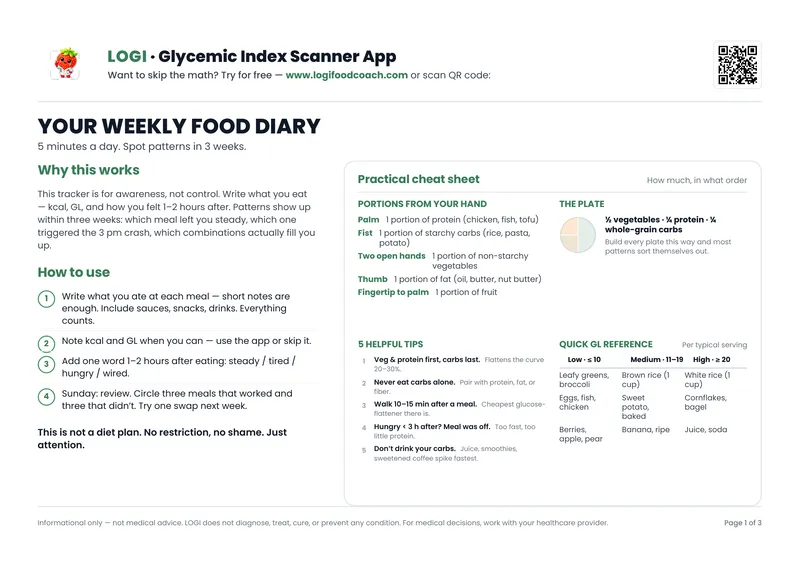
Free PDF — 3 pages
Your Weekly Food Journal
Track meals, glycemic load & mood. Spot patterns in 3 weeks.
No spam. Unsubscribe anytime.