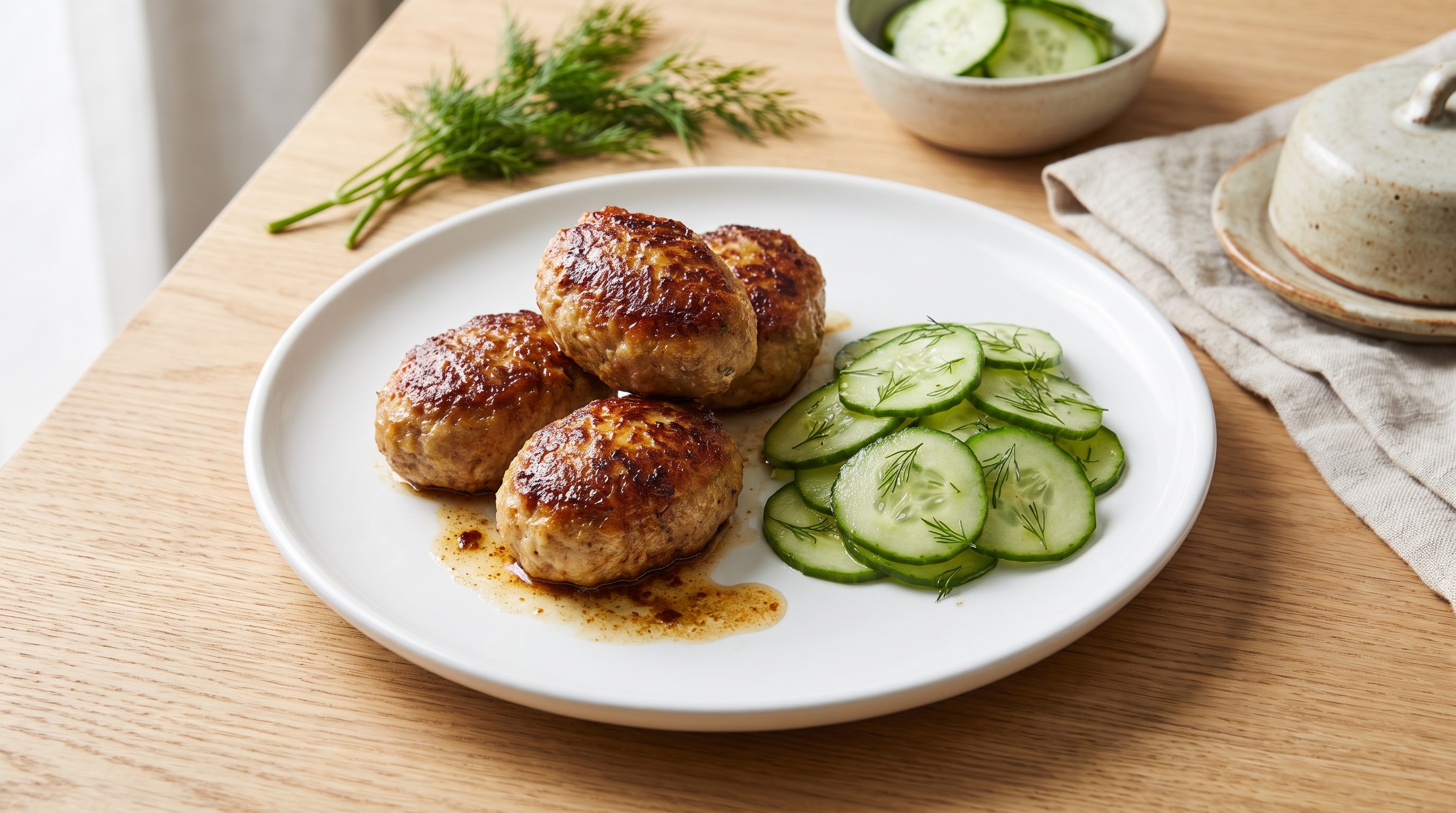
Low-GI Frikadeller with Agurkesalat
Danish pan-fried meatballs made blood-sugar-friendly with rolled oats instead of breadcrumbs, paired with a sugar-free cucumber-dill salad for a satisfying low-GI meal.
Frikadeller are the pride of Danish home cooking — golden, juicy meatballs that appear on dinner tables across the country. Traditional recipes bind the meat with white breadcrumbs soaked in milk, which causes a rapid rise in blood glucose. This version swaps in rolled oats, a low-GI whole grain rich in beta-glucan, the soluble fiber clinically shown to slow glucose absorption and improve insulin sensitivity. The oats soak up the milk just as breadcrumbs would, creating the same tender, moist texture without the glycemic penalty.
The accompanying agurkesalat — Denmark's iconic cucumber-dill salad — traditionally includes a spoonful of white sugar in its dressing. Here, we skip it entirely. White wine vinegar provides all the brightness the salad needs, while paper-thin cucumber slices release their own natural moisture to create a light, refreshing side. Cucumbers rank extremely low on the glycemic index and add volume and hydration to the plate without measurable impact on blood sugar.
For the best glycemic outcome, eat the agurkesalat first. Starting a meal with non-starchy vegetables and vinegar has been shown to reduce post-meal glucose spikes by up to 30 percent. The high protein content from pork and egg further stabilizes the blood sugar response, making this a well-balanced plate that keeps you satisfied for hours without an energy crash.
Blood Sugar Impact
Very low impact expected. With a glycemic load of 7.0 and GI of 39, this protein-rich meatball dish with oat flakes as the primary carb source will produce a gentle, slow rise in blood sugar, supported by the high fat and protein content from pork, egg, and butter that significantly slow gastric emptying.
Blood Sugar Tips
- ✓ Eat the agurkesalat (cucumber salad) first — the white wine vinegar it contains has been shown to reduce postprandial glucose response by up to 30% when consumed before the main course.
- ✓ Avoid mashing or over-processing the oat flakes; keeping them coarser preserves their intact cell structure, which slows starch digestion and lowers the effective GI.
- ✓ Take a 15-minute walk after eating — the combination of moderate carbs from oat flakes and the post-meal movement will help your muscles absorb glucose directly, keeping blood sugar stable for 3-4 hours.
🥗 Ingredients
- 30 g Rolled oats
- 60 ml Whole milk
- 60 g Onion
- 300 g Ground pork
- 1 pcs Egg
- 4 g Salt
- 1 g Black pepper
- 20 g Butter
- 200 g Cucumber
- 20 ml White wine vinegar
- 5 g Dill
- 1.1 oz Rolled oats
- 4 tbsp Whole milk
- 2.1 oz Onion
- 10.6 oz Ground pork
- 1 pcs Egg
- 0.1 oz Salt
- 0.0 oz Black pepper
- 0.7 oz Butter
- 7.1 oz Cucumber
- 1 tbsp White wine vinegar
- 0.2 oz Dill
👨🍳 Instructions
- 1
Place the rolled oats in a small bowl, pour the milk over them, and stir once. Set aside for 5 minutes so the oats absorb the liquid fully and soften into a paste-like consistency. This soaking step is key — it replaces the traditional breadcrumb binder while adding blood-sugar-stabilizing soluble fiber.
- 2
Peel and finely grate the onion using a box grater, catching all the juice. Add the grated onion to a large mixing bowl along with the ground pork, soaked oats, egg, 3 g of the salt, and the black pepper.
- 3
Mix the meat mixture gently with a fork until the ingredients are just combined and the mass holds together. Avoid kneading or over-mixing — working the proteins too aggressively will produce dense, tough frikadeller rather than the light, juicy texture you want.
- 4
Dampen your hands with cold water to prevent sticking. Divide the mixture into 4 equal portions and shape each into an oval patty roughly 8 cm long and 2 cm thick. Traditional frikadeller are oblong, not round — this shape ensures even cooking and a generous golden crust on both flat sides.
- 5
Set a non-stick frying pan over medium heat and add the butter. Once it melts and begins to foam, carefully lay the patties in the pan. Fry undisturbed for 5 to 6 minutes until the underside develops a deep golden-brown crust.
- 6
Flip each frikadelle with a spatula and cook the second side for another 5 to 6 minutes. The meatballs are done when they are golden on both sides and reach an internal temperature of 72 °C. If you don't have a thermometer, press the center gently — it should feel firm with no give.
- 7
While the frikadeller cook, prepare the agurkesalat. Slice the cucumber as thinly as possible — a mandoline set to 1–2 mm works best, but a sharp knife and patience will do. Transfer the slices to a bowl and toss with the white wine vinegar, the remaining 1 g of salt, and roughly torn dill leaves.
- 8
Let the cucumber salad rest at room temperature for at least 5 minutes before serving. The salt draws out moisture from the slices and the vinegar softens them into a silky, lightly pickled side. Serve the agurkesalat alongside the hot frikadeller. For the best blood sugar response, eat a few bites of the vinegar-dressed salad before starting on the meatballs.
📊 Nutrition Per Serving
| Per Serving | Whole Dish | |
|---|---|---|
| Calories | 609 | 1218 |
| Carbs | 18g | 36g |
| Sugars | 5g | 10g |
| Natural Sugars | 5g | 10g |
| Protein | 33g | 66g |
| Fat | 44g | 88g |
| Saturated Fat | 18g | 36g |
| Unsaturated Fat | 26g | 51g |
| Fiber | 3g | 5g |
| Soluble Fiber | 1g | 2g |
| Insoluble Fiber | 2g | 4g |
| Sodium | 921mg | 1842mg |
Predicted Glucose Response
What if you...
Estimated model — individual responses vary. Not medical advice.
🔄 Lower GI Swaps
White breadcrumbs have a GI of 70–75. Rolled oats (GI ~55) contain beta-glucan, a soluble fiber that forms a gel in the gut, slowing glucose absorption and reducing post-meal blood sugar spikes. They soak up milk and bind the meat just as effectively as breadcrumbs.
White sugar (GI 65) adds an unnecessary glycemic load to a side dish that doesn't need it. The vinegar's acidity and the cucumber's natural moisture create a balanced dressing without any added sugar, and the acetic acid in vinegar actively helps lower post-meal blood glucose.
Whole milk has a low GI (~30) and works well in this recipe. However, for those seeking to further minimize carbohydrate intake or who find lactose affects their blood sugar response, unsweetened almond milk (GI ~25, near-zero carbs) or unsweetened coconut milk from a carton (GI ~40, very low carbs) are effective alternatives that still allow the oats to hydrate properly.
Ground pork is glycemically neutral (GI 0), so this swap does not change the blood sugar impact. However, leaner poultry options reduce saturated fat, which some research suggests may improve long-term insulin sensitivity. If using turkey or chicken, add an extra tablespoon of olive oil to the pan to ensure the frikadeller stay moist and develop a good crust.
🔬 The Science Behind This Recipe
Why Rolled Oats Beat Breadcrumbs for Blood Sugar
White breadcrumbs have a GI of around 70–75, making them one of the fastest-absorbing grain products. Rolled oats sit at roughly 55 and bring a secret weapon: beta-glucan, a viscous soluble fiber that forms a gel in your digestive tract. This gel physically slows the rate at which glucose passes from your stomach into your bloodstream.
A 2021 meta-analysis in the Journal of Functional Foods confirmed that even modest amounts of oat beta-glucan (as little as 3 g per day) significantly reduce post-meal blood glucose and insulin responses. The 30 g of rolled oats in this recipe contributes approximately 1.2 g of beta-glucan per serving — a meaningful dose when combined with the other glucose-slowing elements on the plate.
The Vinegar Effect
The white wine vinegar in the agurkesalat is not just for flavor. Acetic acid delays gastric emptying and enhances muscle glucose uptake, reducing post-meal blood sugar spikes by up to 20–30 percent in clinical studies. Eating the vinegar-dressed salad before the meatballs amplifies this effect, as the acetic acid is already at work in your stomach when the carbohydrates from the oats arrive.
Protein and Fat as Glucose Buffers
Ground pork, egg, and butter contribute substantial protein and fat to this meal, both of which slow gastric emptying and stimulate incretin hormones (GLP-1 and GIP) that enhance insulin secretion in a glucose-dependent manner. This means the carbohydrates from the oats are absorbed gradually rather than flooding the bloodstream all at once. The estimated glycemic load of 7 per serving places this meal firmly in the low-GL category (under 10), making it suitable for blood sugar management.
Related recipes
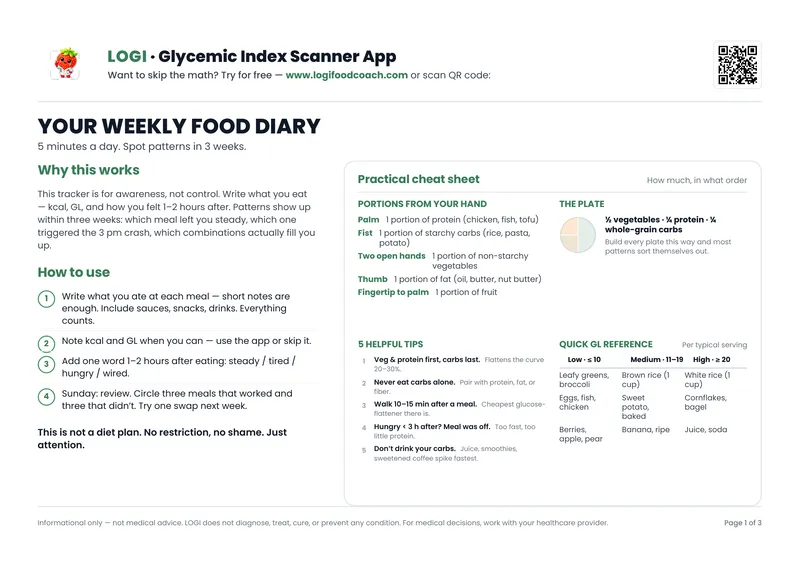
Free PDF — 3 pages
Your Weekly Food Journal
Track meals, glycemic load & mood. Spot patterns in 3 weeks.
No spam. Unsubscribe anytime.