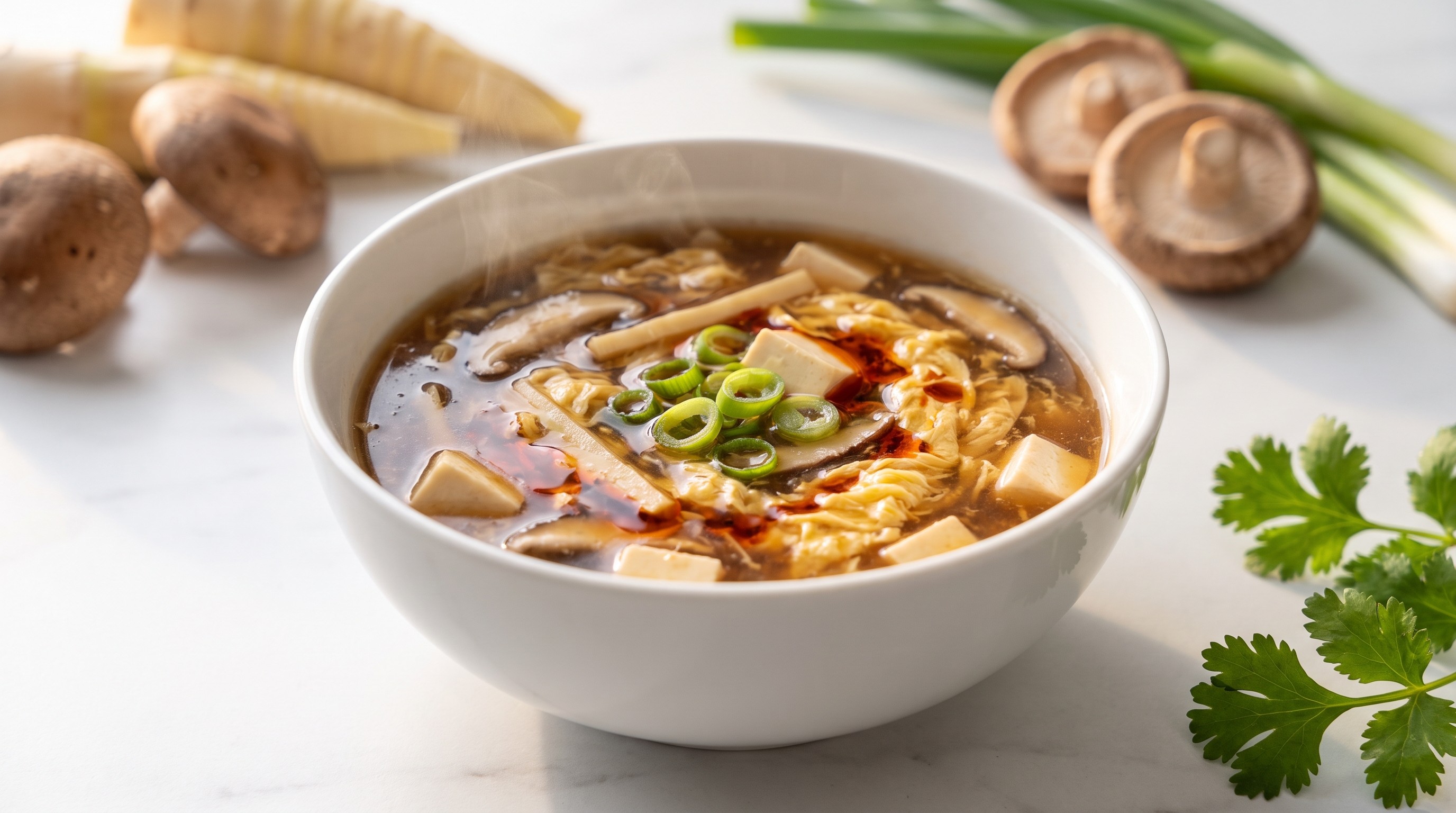
Lighter Hot and Sour Soup with Tofu and Egg Ribbons
A barely-thickened Sichuan hot and sour broth loaded with tofu, shiitakes, and silky egg ribbons — bold flavour, minimal glucose impact.
This streamlined hot and sour soup keeps every bit of the vinegar-and-white-pepper punch you crave from the Sichuan original, but slashes the starch load by roughly eighty percent. Where restaurant versions lean on a heavy cornstarch slurry that can send blood sugar climbing, this recipe uses barely a teaspoon — just enough to give the broth the faintest silky body without turning it into a glucose bomb. The result is a soup that feels light and clean while still delivering serious depth.
From a glycemic standpoint, this bowl is remarkably well composed. Firm tofu and beaten eggs supply a double hit of protein that blunts any residual glucose response, while shiitake mushrooms and bamboo shoots add fibre and bulk with almost no digestible carbohydrate. Rice vinegar, which forms the sour backbone of the dish, has been shown in studies to modestly improve post-meal insulin sensitivity — so the signature tang is doing double duty. Ginger and white pepper further support metabolic function and circulation.
For the best blood-sugar outcome, sip the broth and eat the vegetables and tofu before finishing any rice you might serve alongside. Better yet, skip the rice entirely and let the protein-rich broth stand on its own — it is satisfying enough. This soup also makes an excellent first course before a larger meal: the vinegar and protein prime your metabolism for whatever follows.
Blood Sugar Impact
Very low blood sugar impact expected. With a glycemic load of 7.5 and GI of 38, combined with protein from tofu and egg plus fiber from shiitake and bamboo shoots, this soup should produce a gentle, gradual rise in blood glucose with stable energy for 2-3 hours.
Blood Sugar Tips
- ✓ Eat the solid components first — tofu, mushrooms, bamboo shoots, and egg ribbons — before sipping the broth, so protein and fiber slow gastric emptying.
- ✓ Keep the cornstarch to the minimum needed for texture; it is the primary glucose driver in this recipe, and even a small reduction meaningfully lowers the already-low glycemic load.
- ✓ Take a 10-15 minute walk after the meal to further blunt any modest post-prandial rise from the starch.
🥗 Ingredients
- 10 pcs Ginger
- 600 ml Chicken stock
- 20 g Light soy sauce
- 100 g Shiitake mushroom
- 80 g Bamboo shoot
- 200 g Firm tofu
- 6 g Cornstarch
- 2 pcs Egg
- 30 g Rice vinegar
- 2 g White pepper
- 8 g Sesame oil
- 20 g Spring onion
- 10 g Chili oil
- 10 pcs Ginger
- 2.5 cups Chicken stock
- 0.7 oz Light soy sauce
- 3.5 oz Shiitake mushroom
- 2.8 oz Bamboo shoot
- 7.1 oz Firm tofu
- 0.2 oz Cornstarch
- 2 pcs Egg
- 1.1 oz Rice vinegar
- 0.1 oz White pepper
- 0.3 oz Sesame oil
- 0.7 oz Spring onion
- 0.4 oz Chili oil
👨🍳 Instructions
- 1
Peel and finely slice the ginger. Remove the stems from the shiitake mushrooms and slice the caps thinly. Drain the bamboo shoots and cut them into thin matchstick strips. Cut the tofu into 1 cm-wide strips. Beat the eggs in a small bowl.
- 2
In a small dish, stir the cornstarch together with two tablespoons of cold water until completely smooth. Set the slurry aside — it thickens quickly, so you will stir it again just before adding it to the pot.
- 3
Pour the chicken stock into a medium saucepan, add the ginger slices, and bring everything to a steady simmer over medium heat. Let the ginger infuse for about a minute.
- 4
Add the sliced shiitake mushrooms, bamboo shoot strips, soy sauce, and tofu to the simmering stock. Cook for about five minutes, until the mushrooms are tender and the tofu has warmed through.
- 5
Give the cornstarch slurry a quick stir to recombine it, then pour it into the soup in a thin stream while stirring constantly. Continue stirring for about one minute — the broth should take on the faintest silky body but remain easily pourable, not thick or glossy.
- 6
Turn the heat down to low so the surface of the soup is barely trembling. Hold the bowl of beaten eggs above the pot and pour them in a very thin, steady stream while stirring the soup slowly in one direction with chopsticks or a fork. The eggs should set into long, delicate ribbons.
- 7
Take the pan off the heat immediately. Stir in the rice vinegar, ground white pepper, and toasted sesame oil. Taste and adjust the balance of sour, spicy, and salty to your preference.
- 8
Ladle the soup into two warmed bowls. Scatter the sliced spring onions over the top and finish each bowl with a drizzle of chili oil. Serve straight away.
📊 Nutrition Per Serving
| Per Serving | Whole Dish | |
|---|---|---|
| Calories | 368 | 736 |
| Carbs | 20g | 39g |
| Sugars | 4g | 8g |
| Added Sugars | 0g | 1g |
| Natural Sugars | 4g | 7g |
| Protein | 27g | 54g |
| Fat | 20g | 41g |
| Saturated Fat | 4g | 8g |
| Unsaturated Fat | 17g | 33g |
| Fiber | 3g | 6g |
| Soluble Fiber | 1g | 2g |
| Insoluble Fiber | 2g | 5g |
| Sodium | 2122mg | 4243mg |
Predicted Glucose Response
What if you...
Estimated model — individual responses vary. Not medical advice.
🔄 Lower GI Swaps
Corn starch has a very high GI (~85) and is the main glycemic load driver in this soup. Konjac powder (glucomannan) is a soluble fiber with virtually zero GI that thickens effectively at small doses. Ground flaxseed adds body with negligible glycemic impact and extra fiber that slows glucose absorption. Xanthan gum thickens with no measurable effect on blood sugar.
Many commercial chicken stocks contain added sugars, maltodextrin, or dextrose that quietly raise glycemic load. Homemade bone broth has zero added sugars and its higher collagen/protein content helps moderate the overall glycemic response of the meal. If using store-bought, choose a brand explicitly labeled sugar-free with no maltodextrin in the ingredients.
Standard soy sauce can contain small amounts of added sugar or glucose syrup depending on the brand. Pure tamari is typically brewed without added sweeteners, keeping glycemic impact near zero. Coconut aminos (choose a reduced-sugar version) and liquid aminos also provide umami depth with a lower sugar content per serving.
Seasoned rice vinegar often contains added sugar (2-4 g per tablespoon), which contributes unnecessary glycemic load. Unseasoned black vinegar (Chinkiang) is traditional in hot and sour soup and contains no added sugar while delivering a deeper, more complex acidity. Apple cider vinegar has been shown in studies to help attenuate post-meal blood sugar spikes by slowing gastric emptying.
🔬 The Science Behind This Recipe
Here's the science explainer for this recipe:
---
Why This Soup Loves Your Blood Sugar
This Lighter Hot and Sour Soup is a standout for steady energy, and it starts with what's *not* in the bowl — heavy starches. With a glycemic load of just 7.5 per serving (anything under 10 is considered low) and an estimated GI of 38, this soup sits comfortably in the "gentle on blood sugar" zone. But what makes the numbers so friendly? It comes down to three key players: tofu, shiitake mushrooms, and bamboo shoots. Tofu brings plant-based protein and fat, both of which slow the rate at which your body absorbs glucose. Think of protein and fat as speed bumps on the road to your bloodstream — they prevent the kind of rapid sugar rush that leads to an energy crash an hour later. Shiitake mushrooms and bamboo shoots, meanwhile, are packed with dietary fiber, which acts like a sponge in your digestive system, absorbing water and creating a gel-like consistency that further slows glucose absorption.
Here's where the concept of glycemic load really shines. You might hear that a food has a "low GI," but what matters just as much is *how much* of that food you're eating. Glycemic load accounts for both the quality and quantity of carbohydrates in a serving. This soup's GL of 7.5 tells you that not only are the carbs slow-releasing, but there simply aren't many of them per bowl — the bulk of the dish is protein, water, and vegetables.
Want to maximize the blood sugar benefits? Try eating the vegetables and tofu first before sipping the broth, since fiber and protein consumed before carbohydrates have been shown to blunt glucose spikes. Pairing ginger — which some research suggests may support healthy glucose metabolism — with the vinegar already in a classic hot and sour soup creates a double advantage, as acidity can also slow gastric emptying. And if you can, take a 10–15 minute walk after your meal. Even light movement helps your muscles pull glucose from the bloodstream, keeping your levels smooth and steady well into the afternoon.
Related recipes
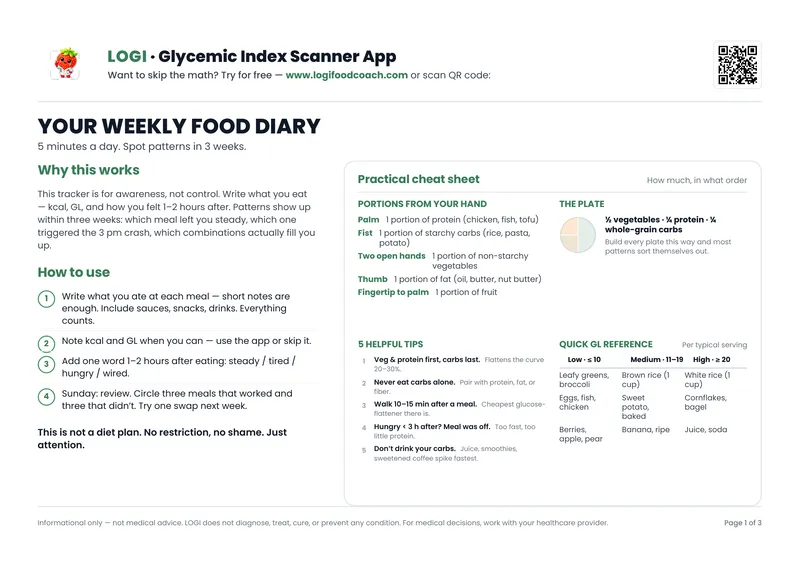
Free PDF — 3 pages
Your Weekly Food Journal
Track meals, glycemic load & mood. Spot patterns in 3 weeks.
No spam. Unsubscribe anytime.