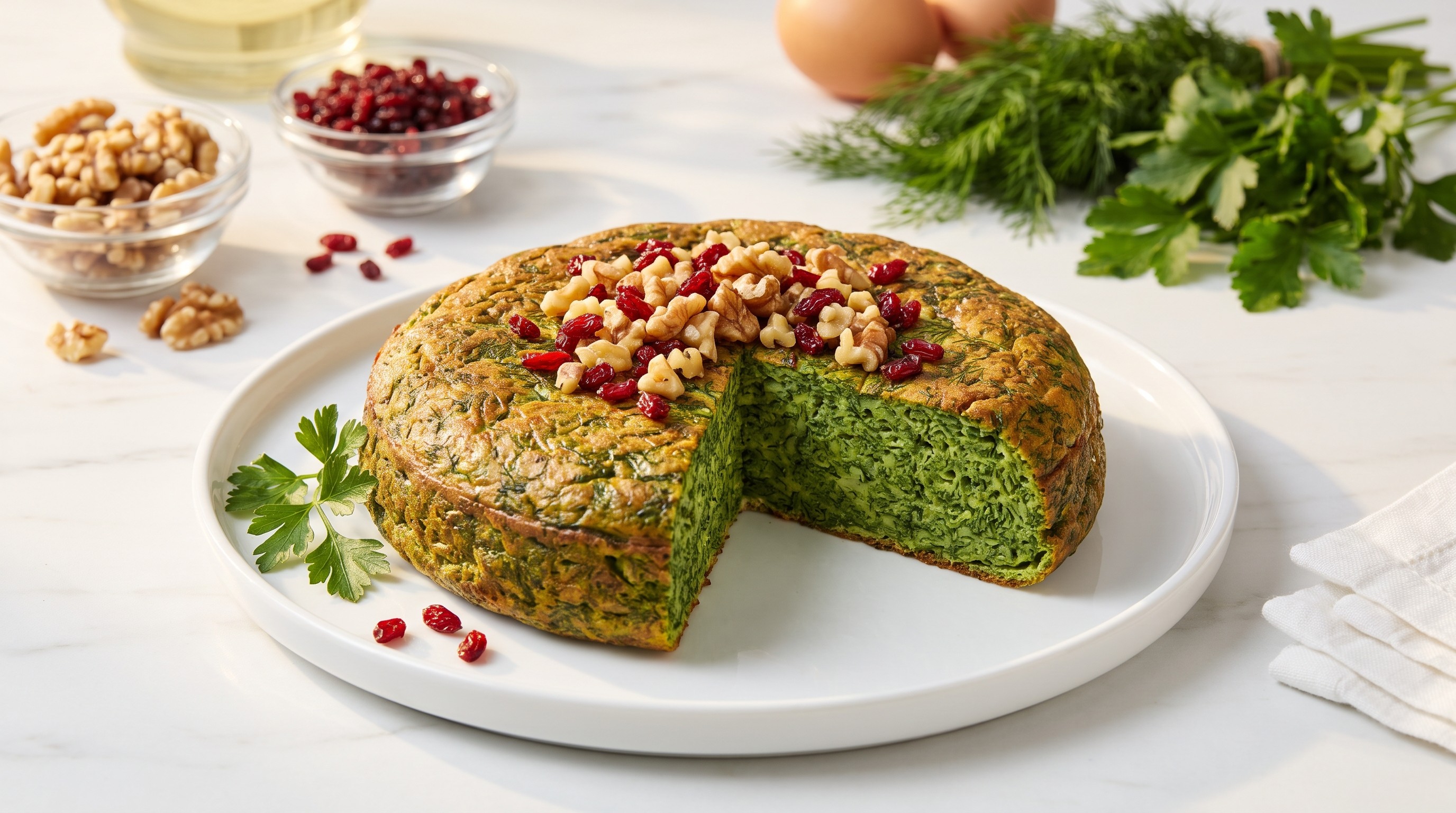
Kuku Sabzi (Persian Herb Frittata)
A fragrant Persian herb frittata packed with parsley, cilantro, and dill — virtually zero-carb, rich in protein and healthy fats for steady blood sugar all day.
Kuku sabzi is one of the most blood-sugar-friendly dishes in the entire Persian repertoire. Built on an enormous base of fresh herbs — parsley, cilantro, and dill — bound together by protein-rich eggs, it delivers a dense, aromatic wedge that is almost entirely free of carbohydrate. Without the tablespoon of white flour that some versions call for, the glycemic load of a generous serving hovers near zero, making this an ideal centrepiece for anyone managing their glucose response.
The combination of six whole eggs and a handful of walnuts provides a sustained release of energy through protein and monounsaturated fat, both of which blunt any residual blood-sugar rise from the small amount of dried barberries folded into the batter. Those tart little berries, known as zereshk, contribute antioxidants and a bright pop of flavour without meaningful sugar impact at just twenty grams for the entire dish. Turmeric rounds out the spice profile and brings its own well-documented anti-inflammatory benefits, which are increasingly linked to improved insulin sensitivity.
Serve kuku sabzi at room temperature alongside a simple cucumber-yoghurt side or a crisp fattoush salad with extra-virgin olive oil dressing. Eating the vegetable side first allows fibre to reach the gut ahead of other macronutrients, further flattening the glucose curve. This frittata also keeps beautifully in the fridge for two to three days, making it perfect for meal prep — slice cold wedges for a grab-and-go breakfast or a satisfying lunch that will not trigger an afternoon energy crash.
Blood Sugar Impact
Moderate blood sugar impact due to a medium glycemic load (18.7), but the low GI (46), high protein from eggs, and healthy fats from walnuts and olive oil will slow glucose absorption, resulting in a gradual, manageable rise rather than a sharp spike.
Blood Sugar Tips
- ✓ Pair with a side of non-starchy vegetables like a cucumber-tomato salad to add fiber and further blunt the glucose response.
- ✓ Take a 10-15 minute walk after eating to help your muscles absorb circulating blood sugar more efficiently.
- ✓ Avoid pairing with high-GI sides like white rice or flatbread; opt for a small portion of intact whole grains or legumes instead.
🥗 Ingredients
- 6 pcs Egg
- 100 g Flat-leaf parsley
- 80 g Cilantro
- 50 g Dill
- 120 g Spring onion
- 40 g Walnut
- 20 g Dried barberry
- 0.5 tsp Ground turmeric
- 1.5 tbsp Olive oil
- 0.75 tsp Fine salt
- 0.25 tsp Black pepper
- 6 pcs Egg
- 3.5 oz Flat-leaf parsley
- 2.8 oz Cilantro
- 1.8 oz Dill
- 4.2 oz Spring onion
- 1.4 oz Walnut
- 0.7 oz Dried barberry
- 0.5 tsp Ground turmeric
- 1.5 tbsp Olive oil
- 0.75 tsp Fine salt
- 0.25 tsp Black pepper
👨🍳 Instructions
- 1
Set the oven to 180 °C (355 °F) so it is fully heated by the time you need it. Place the dried barberries in a small bowl, cover them with warm water, and leave them to plump up while you prepare the rest of the ingredients.
- 2
Rinse the parsley, cilantro, and dill under cold running water. Dry them thoroughly using a salad spinner followed by a clean kitchen towel — excess moisture will steam the frittata instead of letting it set properly.
- 3
Finely chop all three herbs and thinly slice the spring onions. Gather everything into a large mound — you should have roughly 350 g of prepared greens. Roughly chop the walnuts and set aside.
- 4
Crack the eggs into a large mixing bowl. Add the turmeric, salt, and black pepper, then whisk briskly until the mixture is evenly coloured and no streaks of white remain.
- 5
Fold the chopped herbs, sliced spring onions, and walnuts into the beaten eggs. Drain the soaked barberries, press them gently with a paper towel to remove excess water, and fold them in as well. The batter will appear almost solid with greenery — this is exactly how it should look.
- 6
Warm the olive oil in a 20 cm (8-inch) oven-safe skillet over medium heat, tilting the pan to coat the base and sides. Scrape the herb-egg mixture into the skillet, spreading it evenly and pressing the surface flat with a spatula. Cook without disturbing for about 3 minutes until the underside begins to firm up.
- 7
Transfer the skillet to the preheated oven and bake for 20 to 25 minutes. The kuku sabzi is done when the top feels firm and dry to the touch and the edges have turned golden brown.
- 8
Remove the skillet from the oven and let the frittata rest in the pan for 5 minutes — this makes slicing cleaner. Run a spatula around the edge, slide or invert the kuku onto a board, and cut into wedges. Serve warm or at room temperature.
📊 Nutrition Per Serving
| Per Serving | Whole Dish | |
|---|---|---|
| Calories | 625 | 1249 |
| Carbs | 41g | 82g |
| Sugars | 7g | 14g |
| Added Sugars | 2g | 4g |
| Natural Sugars | 5g | 11g |
| Protein | 26g | 53g |
| Fat | 40g | 80g |
| Saturated Fat | 8g | 15g |
| Unsaturated Fat | 32g | 64g |
| Fiber | 7g | 13g |
| Soluble Fiber | 2g | 4g |
| Insoluble Fiber | 5g | 9g |
| Sodium | 2648mg | 5295mg |
Predicted Glucose Response
What if you...
Estimated model — individual responses vary. Not medical advice.
🔄 Lower GI Swaps
White flour is a high-GI refined carbohydrate (GI ~70) that would unnecessarily raise the glycemic load. Eggs alone bind the herbs perfectly, keeping the dish virtually carbohydrate-free.
Dried barberries contain natural sugars, though at 20 g for the entire dish the impact is minimal (about 2–3 g sugar per serving). Halving the amount further reduces blood sugar impact while preserving the characteristic tart flavour.
🔬 The Science Behind This Recipe
This recipe is built almost entirely from protein (eggs), healthy fats (walnuts, olive oil), and non-starchy vegetables (fresh herbs, spring onions), so its total available carbohydrate per serving is remarkably low — roughly 10 g. The glycemic index of the small carbohydrate fraction sits around 38, driven mainly by the natural sugars in 20 g of dried barberries split across two servings and the modest carbohydrate in the spring onions. At a glycemic load of 4, this falls well within the low category (under 10), meaning it will produce only a minimal rise in blood glucose. The protein from six eggs triggers a steady insulin response that helps clear glucose efficiently, while the monounsaturated and polyunsaturated fats in walnuts and olive oil further delay gastric emptying, keeping the glucose curve flat. Turmeric contains curcumin, which research has linked to improved insulin sensitivity and reduced fasting blood sugar over time. Dried barberries (zereshk) do contain some natural sugars — roughly 2–3 g per serving in this recipe — but at such a small quantity their impact is negligible, and they contribute beneficial antioxidants including berberine, a compound studied for its glucose-lowering properties.
Related recipes
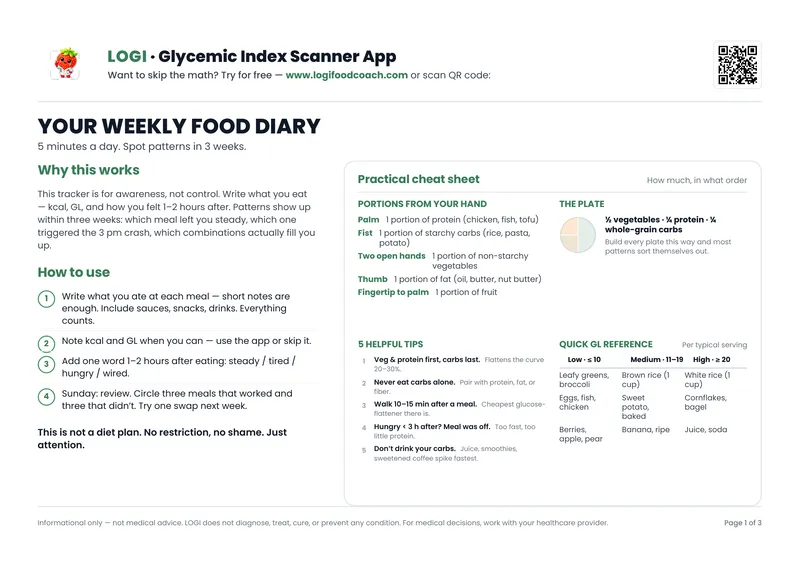
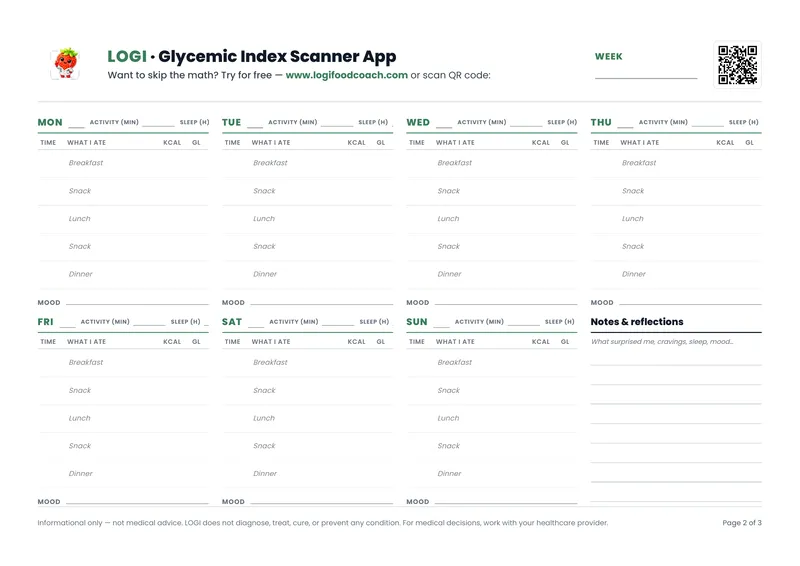
Free PDF — 3 pages
Your Weekly Food Journal
Track meals, glycemic load & mood. Spot patterns in 3 weeks.
No spam. Unsubscribe anytime.