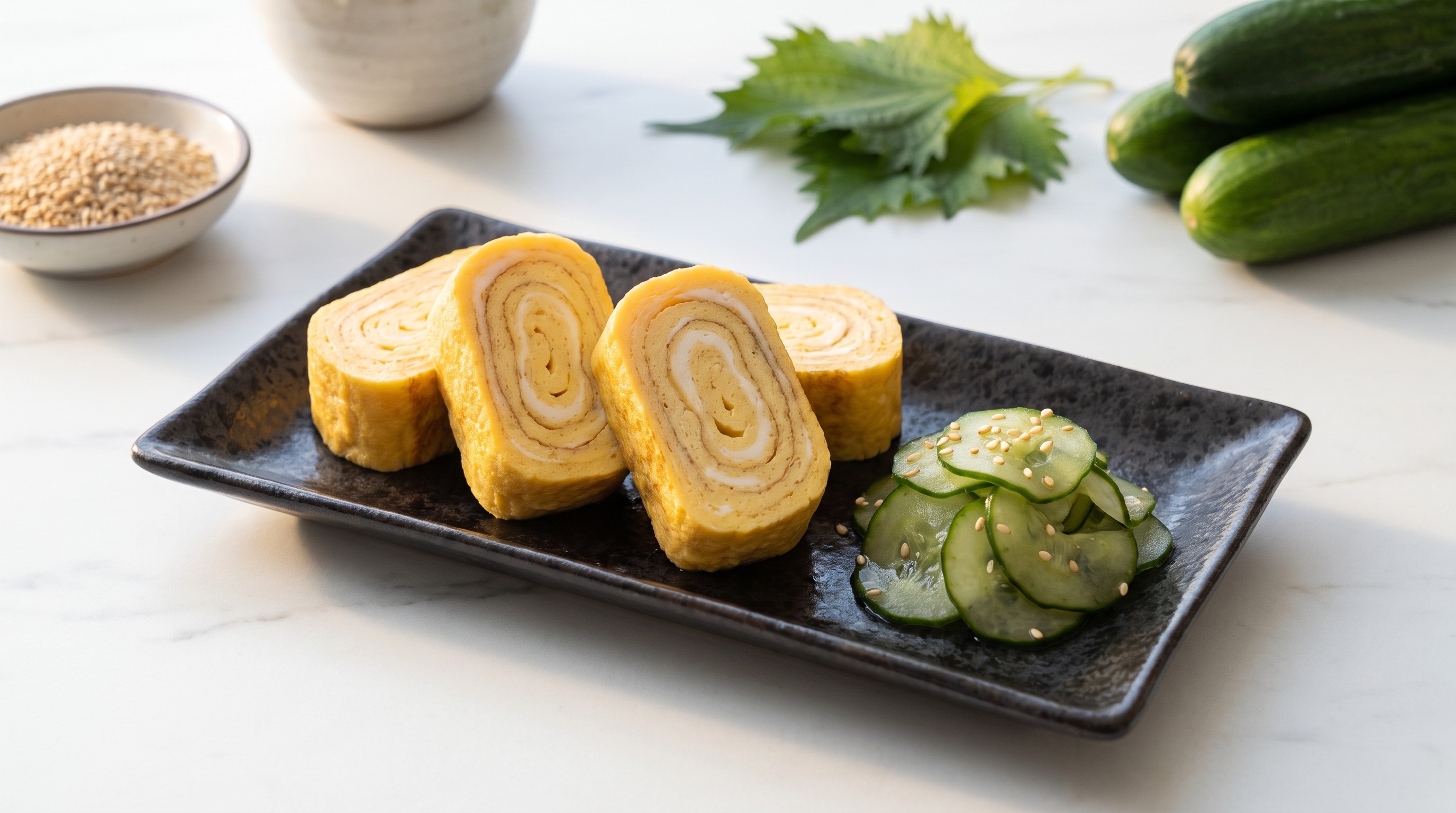
Dashimaki Tamago with Cucumber Sunomono
Savoury dashi-rolled omelette paired with tangy sesame-cucumber salad — protein-rich, virtually carb-free, and ideal for steady blood sugar.
Dashimaki tamago is the Kansai-region approach to Japanese rolled omelette — enriched with umami-rich dashi broth instead of sugar, making it a naturally blood-sugar-friendly centrepiece. Each thin layer of seasoned egg is rolled upon itself to create a tender, custard-like interior with delicate golden edges. Because the protein and fat in eggs produce almost no glycemic response, this dish is as close to zero-impact on blood glucose as a satisfying main can get.
The accompanying cucumber sunomono provides a bright, vinegar-dressed counterpoint. Rice vinegar is a well-studied ally for glycemic control: acetic acid slows gastric emptying and improves post-meal insulin sensitivity, so even when paired with higher-carb sides at a larger meal, this starter helps blunt the overall glucose spike. The cucumber itself adds hydration, fibre, and virtually no digestible carbohydrate.
Serve the sunomono first and let the vinegar begin its work before moving to the tamagoyaki. For a more complete meal, add a small bowl of chilled edamame or a side of leafy greens dressed with a splash of ponzu — both keep the glycemic load low while rounding out the plate with extra fibre and micronutrients. This dish works beautifully as a light lunch, a bento component, or a protein-forward breakfast that won't send your glucose on a roller coaster.
Blood Sugar Impact
Very minimal blood sugar impact expected. With a glycemic load of just 1.2 and an estimated GI of 21, this protein-rich egg dish paired with vinegar-dressed cucumber should produce a nearly flat glucose response and provide stable energy for 3-4 hours.
Blood Sugar Tips
- ✓ Eat the cucumber sunomono first — the rice vinegar and fiber help blunt any subsequent glucose absorption.
- ✓ Enjoy the meal mindfully and without sugary beverages; pair with green tea or water to maintain the naturally low glycemic response.
- ✓ If serving alongside rice or noodles, keep the starchy side small and eat the dashimaki tamago and sunomono before the carbohydrate portion.
🥗 Ingredients
- 1 pcs Cucumber
- 0.5 tsp Fine salt
- 2 tbsp Rice vinegar
- 4 tsp Soy sauce
- 4 pcs Egg
- 3 tbsp Dashi stock
- 2 tsp Vegetable oil
- 1 tsp White sesame seeds
- 1 pcs Cucumber
- 0.5 tsp Fine salt
- 2 tbsp Rice vinegar
- 4 tsp Soy sauce
- 4 pcs Egg
- 3 tbsp Dashi stock
- 2 tsp Vegetable oil
- 1 tsp White sesame seeds
👨🍳 Instructions
- 1
Cut the cucumber in half lengthways and use a teaspoon to scoop out the watery seeds from each half. Slice the cucumber crossways as thinly as you can — aim for translucent half-moons.
- 2
Place the cucumber slices in a bowl, sprinkle with the fine salt, and toss to coat evenly. Leave to sit for 10 minutes so the salt draws out excess moisture.
- 3
Take the cucumber in small handfuls and squeeze firmly over the sink to press out as much liquid as possible. Return the squeezed slices to a clean bowl, dress with the rice vinegar and 1 teaspoon of soy sauce, and scatter the sesame seeds on top. Toss gently and refrigerate while you prepare the egg.
- 4
Crack the eggs into a bowl. Add the dashi stock and the remaining 3 teaspoons of soy sauce. Mix using a chopstick or fork in short, cutting strokes — the goal is to break the whites into the yolks without beating air into the mixture. If the surface looks foamy, pour the mixture through a fine-mesh sieve into a clean bowl.
- 5
Place a tamagoyaki pan or small non-stick skillet over medium-low heat and let it warm for about a minute. Fold a piece of paper towel into a small pad, dip it lightly in vegetable oil, and wipe a thin, even film across the cooking surface.
- 6
Pour just enough egg mixture into the pan to coat the bottom in a thin layer. Let it cook until the surface is mostly set but still slightly glossy on top. Using chopsticks or a spatula, carefully roll the egg sheet toward you to form a compact log, then slide the roll to the far end of the pan.
- 7
Re-oil the empty section of the pan with the paper towel pad. Pour another thin layer of egg mixture into the pan, lifting the cooked roll slightly so raw egg flows underneath it to bond with the previous layer. Once the new layer is just set, roll the entire log toward you again. Repeat this process three or four more times until all the egg mixture is used up.
- 8
Transfer the finished roll onto a bamboo sushi mat or a sheet of cling film. Gently press and shape it into an even rectangle, then let it rest for 2 minutes to firm up. Slice crossways into pieces about 2 cm thick. Arrange on a plate alongside the chilled cucumber sunomono and serve immediately.
📊 Nutrition Per Serving
| Per Serving | Whole Dish | |
|---|---|---|
| Calories | 215 | 430 |
| Carbs | 6g | 12g |
| Sugars | 2g | 5g |
| Natural Sugars | 2g | 5g |
| Protein | 14g | 29g |
| Fat | 15g | 31g |
| Saturated Fat | 4g | 8g |
| Unsaturated Fat | 11g | 23g |
| Fiber | 1g | 2g |
| Soluble Fiber | 0g | 1g |
| Insoluble Fiber | 0g | 1g |
| Sodium | 1340mg | 2681mg |
Predicted Glucose Response
What if you...
Estimated model — individual responses vary. Not medical advice.
🔄 Lower GI Swaps
Apple cider vinegar has stronger evidence for blunting post-meal blood sugar spikes due to its higher acetic acid concentration. Studies show it can reduce the glycemic response to a meal by up to 20-30% compared to milder vinegars like rice vinegar.
Extra virgin olive oil and avocado oil contain monounsaturated fats and polyphenols that improve insulin sensitivity and slow gastric emptying, leading to a more gradual glucose release compared to refined vegetable oil which lacks these bioactive compounds.
Standard soy sauce may contain added sugars or wheat-derived carbohydrates that contribute a small glycemic load. Tamari is typically wheat-free with no added sugars, and coconut aminos, while slightly sweet, has a lower glycemic index than regular soy sauce.
Chia and flaxseeds are significantly higher in soluble fiber, which forms a gel in the gut that slows carbohydrate absorption and reduces post-meal glucose spikes. Chia seeds have a GI near 0 and provide more blood-sugar-stabilizing omega-3 fatty acids per serving than sesame seeds.
🔬 The Science Behind This Recipe
Here's the science explainer for the Dashimaki Tamago with Cucumber Sunomono recipe:
---
Why This Recipe Works for Blood Sugar
This dish is a fantastic example of how simple, whole ingredients can work together to keep your blood sugar remarkably steady. The star here is the egg — a near-zero glycemic food packed with protein and healthy fats. When you eat protein, your body digests it slowly, which means glucose trickles into your bloodstream gradually rather than flooding it all at once. The fat in egg yolks takes this a step further by slowing down stomach emptying, giving your body more time to process everything smoothly. With eggs as the foundation of this meal, you're starting from an incredibly stable base.
Cucumber is another quiet hero in this recipe. It's mostly water and fiber with very few digestible carbohydrates, which means it adds satisfying volume and crunch without meaningfully raising your blood sugar at all. The rice vinegar in the sunomono dressing brings an extra benefit that researchers have found quite compelling: vinegar consumed with a meal can help reduce the post-meal glucose response. The acetic acid in vinegar appears to slow carbohydrate digestion, giving your body a gentler curve rather than a sharp spike.
What really makes this recipe shine is its glycemic load of just 1.2 per serving — well below the threshold of 10 that's generally considered "low." Remember, glycemic load accounts for both the type and the amount of carbohydrates you're eating, making it a much more practical measure than glycemic index alone. A food might have a moderate GI, but if a serving contains very few carbs — as is the case here — the actual impact on your blood sugar is minimal. To get even more from this meal, try eating the cucumber sunomono first before the tamago. Starting with vegetables helps create a buffer in your digestive system, and a short 10-15 minute walk after eating can further help your muscles absorb glucose naturally.
Related recipes
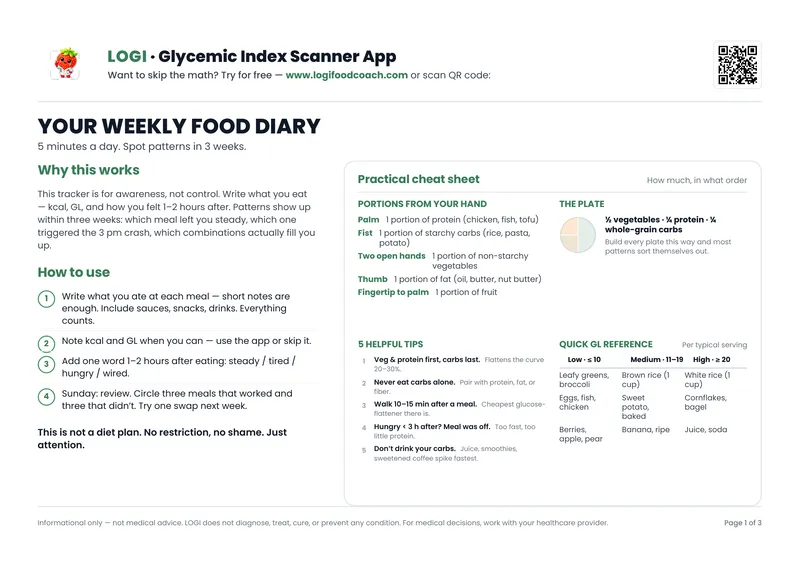
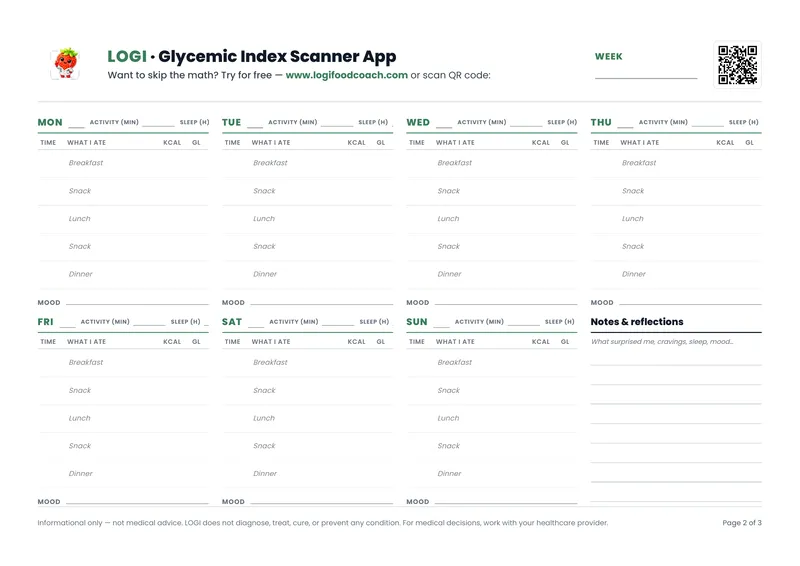
Free PDF — 3 pages
Your Weekly Food Journal
Track meals, glycemic load & mood. Spot patterns in 3 weeks.
No spam. Unsubscribe anytime.