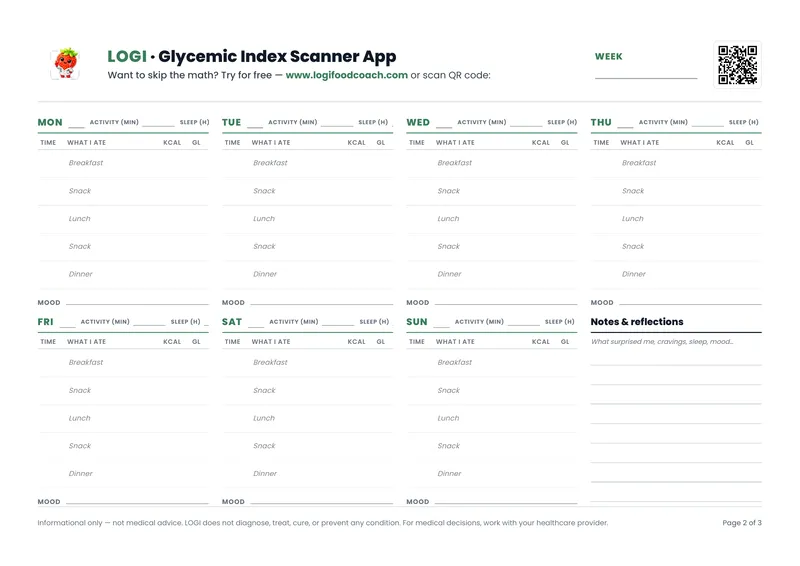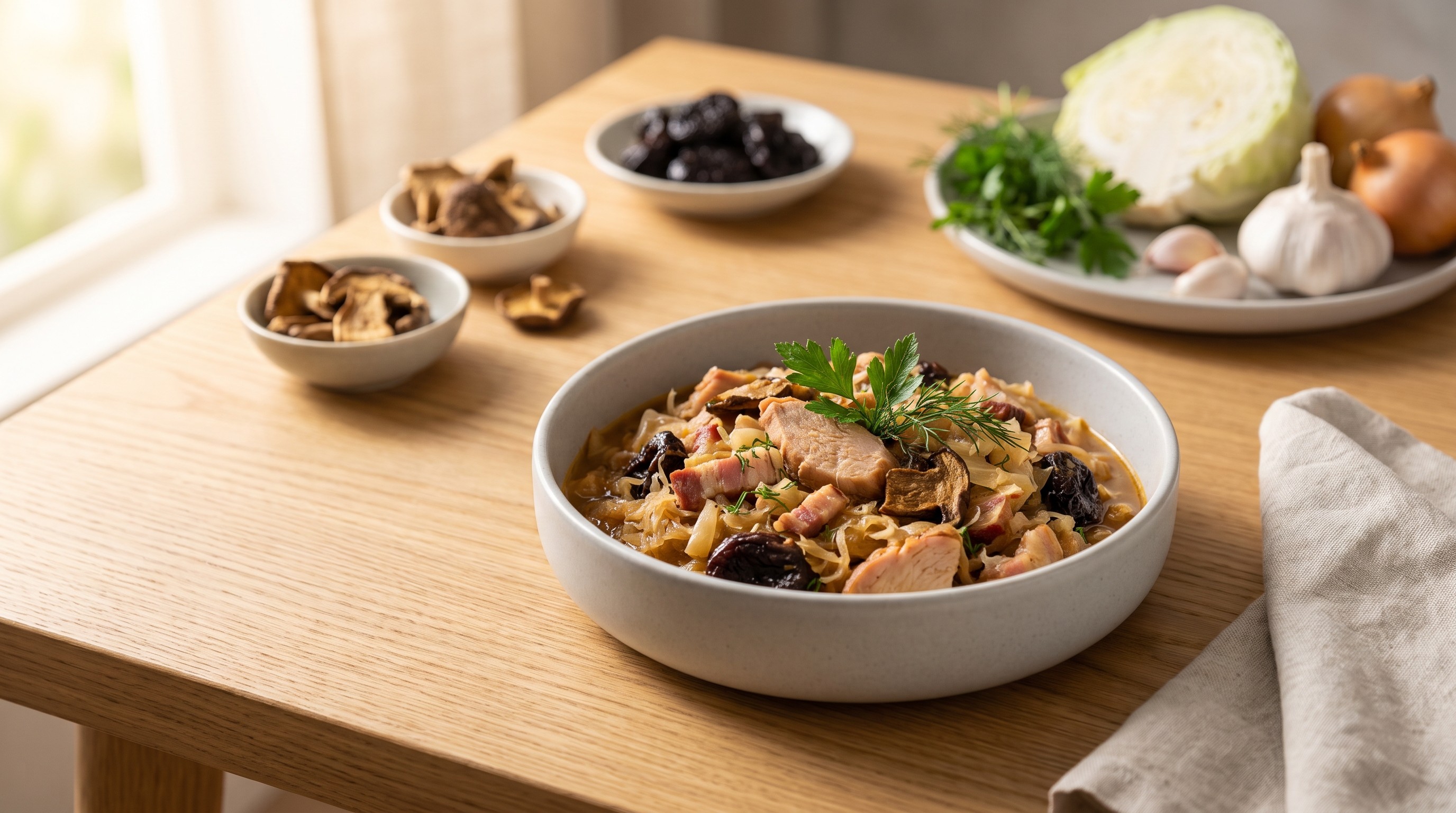
Bigos — Polish Hunter's Stew
A deeply flavoured Polish hunter's stew of sauerkraut, cabbage, smoked turkey and porcini — naturally low-glycemic and better on day two.
Bigos is Poland's national stew, a slow-simmered tangle of sauerkraut and fresh cabbage enriched with smoked meat, dried mushrooms and a handful of prunes. This version leans on smoked turkey breast instead of the traditional fatty pork, keeping saturated fat in check while preserving the smoky backbone the dish demands. A small amount of bacon provides rendered fat for the soffritto — just enough to carry the caraway-juniper spice base without excess.
From a glycemic standpoint, bigos is a natural winner. The base is almost entirely non-starchy vegetables: fermented cabbage (rich in organic acids that slow gastric emptying), fresh cabbage (high fibre, negligible sugar) and dried porcini mushrooms (virtually zero carbohydrate). The only meaningful sugar source is six prunes, distributed across eight servings — roughly 3 g of sugar per bowl, buffered by the stew's high protein and fibre content. Fermented foods like sauerkraut have been shown to support gut-microbiome diversity, which in turn may improve insulin sensitivity over time.
Serve bigos as a complete one-pot meal — it needs nothing alongside it. If you want bread, choose a dense sourdough rye and limit the portion to one thin slice. For the best flavour and the gentlest blood-sugar response, make it a day ahead: reheating breaks down the fibre further, thickens the broth and deepens every flavour. Eat the vegetables and broth first, letting the protein and fat slow digestion before any starch you pair it with.
Blood Sugar Impact
Very low blood sugar impact expected. The combination of high-fiber sauerkraut and cabbage, lean protein from turkey, and healthy fats from bacon creates a slow, steady glucose response with stable energy for 4+ hours.
Blood Sugar Tips
- ✓ Eat the sauerkraut and cabbage portions first — the fiber and probiotics from fermented cabbage prime your gut to slow glucose absorption.
- ✓ Limit the prunes to the recipe's intended portion, as they are the highest-sugar ingredient in this otherwise very low-glycemic dish.
- ✓ Take a 10-15 minute walk after eating to further blunt any minor glucose rise from the tomato paste and prunes.
🥗 Ingredients
- 800 g Sauerkraut
- 600 g White cabbage
- 500 g Smoked turkey breast
- 100 g Bacon
- 30 g Dried porcini mushroom
- 6 pcs Prune
- 2 pcs Yellow onion
- 4 pcs Garlic
- 2 tbsp Tomato paste
- 2 tbsp Spice mix
- 1.8 lb Sauerkraut
- 1.3 lb White cabbage
- 1.1 lb Smoked turkey breast
- 3.5 oz Bacon
- 1.1 oz Dried porcini mushroom
- 6 pcs Prune
- 2 pcs Yellow onion
- 4 pcs Garlic
- 2 tbsp Tomato paste
- 2 tbsp Spice mix
👨🍳 Instructions
- 1
Place the dried porcini mushrooms in a bowl and pour over 250 ml of hot water. Set aside for 20 minutes to rehydrate. Once soft, lift the mushrooms out, chop them roughly and keep the soaking liquid — strain it through a fine sieve or coffee filter to remove any grit.
- 2
Set a heavy-bottomed pot (at least 5 litres) over medium heat. Add the diced bacon and cook for 5–6 minutes, stirring occasionally, until the fat renders out and the pieces turn light gold. Do not let them crisp — you want the fat, not croutons.
- 3
Add the diced onions to the rendered bacon fat and cook for about 8 minutes, stirring now and then, until they soften and turn translucent. Stir in the minced garlic and cook for one more minute until fragrant. Add the tomato paste and the spice mix, then stir constantly for 30 seconds to toast the spices — the paste should darken a shade.
- 4
Increase the heat slightly and add the diced smoked turkey breast. Cook for 3–4 minutes, turning the pieces to develop some colour on the edges. The meat does not need to cook through — it will finish during the long simmer.
- 5
Add the drained sauerkraut, the shredded fresh cabbage, the chopped prunes, the rehydrated mushrooms with their strained liquid, 200 ml of red wine and 200 ml of water. Stir everything together so the cabbage and meat are evenly distributed. The liquid should just barely cover the solids — add a splash more water only if the pot looks dry.
- 6
Bring the stew to a gentle bubble, then lower the heat to the lowest setting. Set the lid ajar — half-covered — and let it simmer for 75–90 minutes. Stir every 15–20 minutes and check the liquid level. The fresh cabbage should melt into the sauerkraut, the liquid should reduce by roughly half and the colour should deepen from grey-green to a rich mahogany.
- 7
Remove the pot from the heat, cover it fully and let the stew rest undisturbed for 30 minutes. This rest is essential — it allows the fat to redistribute, the spices to meld and the acidity of the sauerkraut to mellow into the broth.
- 8
Taste and adjust seasoning with salt, pepper or a splash of wine vinegar if needed. Serve hot in deep bowls. For the best flavour and gentlest glycemic response, cool the stew to room temperature, refrigerate overnight and reheat gently the next day — bigos improves dramatically on day two or three. Portions freeze beautifully for up to three months.
📊 Nutrition Per Serving
| Per Serving | Whole Dish | |
|---|---|---|
| Calories | 225 | 1803 |
| Carbs | 20g | 157g |
| Sugars | 10g | 76g |
| Natural Sugars | 10g | 76g |
| Protein | 23g | 185g |
| Fat | 6g | 51g |
| Saturated Fat | 2g | 16g |
| Unsaturated Fat | 4g | 30g |
| Fiber | 7g | 57g |
| Soluble Fiber | 2g | 18g |
| Insoluble Fiber | 5g | 39g |
| Sodium | 926mg | 7407mg |
Predicted Glucose Response
What if you...
Estimated model — individual responses vary. Not medical advice.
🔄 Lower GI Swaps
Prunes have a moderate GI (~29) but are very sugar-dense when dried, contributing concentrated natural sugars. Unsweetened dried cranberries or sour cherries have lower sugar content per serving, and fresh plum offers the same flavor profile with more fiber and water to slow glucose absorption.
Tomato paste is highly concentrated, packing more natural sugars per tablespoon than whole tomatoes. Using crushed tomatoes or sun-dried tomatoes delivers similar umami depth with a lower glycemic load due to less sugar concentration and more fiber per serving.
While bacon itself is very low GI, many commercial bacons contain added sugars, maple, or honey in the curing process that can contribute hidden glycemic load. Turkey bacon or uncured options typically have no added sugars, and smoked tempeh adds protein and fiber which further helps moderate blood sugar response.
🔬 The Science Behind This Recipe
Here's the science explainer for Bigos:
---
Why This Stew Is a Blood Sugar Winner
Bigos is a remarkably blood sugar-friendly meal, and it starts with its star ingredient: sauerkraut. Through fermentation, cabbage transforms into a probiotic-rich powerhouse that's naturally very low in carbohydrates. The fermentation process actually consumes much of the sugar present in fresh cabbage, leaving behind beneficial acids and fiber that slow digestion. Paired with fresh cabbage — which is packed with soluble fiber — this duo creates a gentle, steady release of energy rather than a sharp glucose spike. Think of fiber as a natural speed bump for your digestive system: it slows everything down, giving your body time to process nutrients without overwhelming your blood sugar response.
The generous amount of turkey breast in this stew is where the real magic happens. Protein is one of the most effective tools for flattening your glucose curve. When you eat protein alongside any carbohydrates, it signals your body to release insulin more gradually and keeps you feeling full for hours. The small amount of bacon adds healthy fats into the mix, which further slows gastric emptying — the rate at which food leaves your stomach. This fat-protein-fiber combination is essentially the trifecta of blood sugar stability, and Bigos delivers all three in every spoonful.
With a glycemic load of just 4.4 per serving, this dish sits firmly in the "low" category. Remember, glycemic load accounts for both the *type* and *amount* of carbohydrates in a serving — it's a much more useful real-world measure than glycemic index alone. A GL under 10 is considered low, and Bigos comes in at less than half that threshold. To maximize the benefits, try having a short 10-15 minute walk after your meal — even gentle movement helps your muscles absorb glucose more efficiently. And if you're serving this with bread or potatoes on the side, eat the stew first: starting with the protein and vegetables primes your body to handle any carbohydrates that follow.
Related recipes
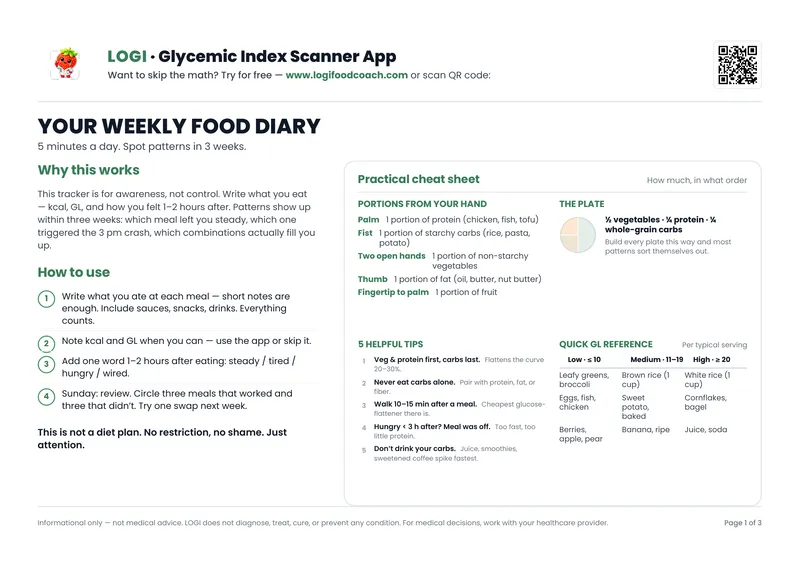
Free PDF — 3 pages
Your Weekly Food Journal
Track meals, glycemic load & mood. Spot patterns in 3 weeks.
No spam. Unsubscribe anytime.