Cottage Cheese Glycemic Index: Why It Is One of the Best Foods for Insulin Resistance

Title: Cottage Cheese Glycemic Index: Why It Is One of the Best Foods for Insulin Resistance Slug: cottage-cheese-glycemic-index Date: 2026-05-01 Author: Logi Team Excerpt: Cottage cheese has a glycemic index of about 30 and a glycemic load near zero — but the real story is the protein-to-carb ratio. Here is what the data shows and how to use it. Tags: cottage cheese, glycemic index, glycemic load, insulin resistance, high protein, low carb, dairy Meta description: Cottage cheese GI is 27–30 with a glycemic load under 2 per cup. 25g of casein protein keeps blood sugar flat. Best brands, pairings, and IR use cases.
Cottage Cheese Glycemic Index: Why It Is One of the Best Foods for Insulin Resistance
If you have insulin resistance, prediabetes, or any condition where blood sugar control matters, cottage cheese deserves more attention than it gets. The numbers are quietly excellent. Most people who track macros land on Greek yogurt because it is trendier, but cottage cheese has a better protein-to-carb ratio, a lower glycemic load, and a different protein profile that keeps you full longer.
This article walks through the data. The actual glycemic index of cottage cheese, why the glycemic load is what matters more, how dairy and insulin interact, what to look for on the label, and how to build cottage cheese into a meal pattern that supports stable blood sugar.
The glycemic index of cottage cheese
The glycemic index of cottage cheese sits between 27 and 30, depending on the variety and the testing method. That puts it firmly in the low range — anything under 55 is considered low, and cottage cheese is well below that threshold.
For comparison, here are some related foods:
- Cottage cheese (1% or 2% milkfat): GI 27–30
- Plain Greek yogurt (full fat): GI 11–14
- Plain regular yogurt: GI 35–41
- Whole milk: GI 27–34
- Ricotta cheese: GI 27 (estimated, low data)
- Cheddar cheese: GI ~0 (no measurable carbs)
- Skim milk: GI 32
Cottage cheese is in the same neighborhood as milk. That is not surprising — it is essentially curds of pasteurized milk with most of the whey drained off. The lactose that remains is the only carbohydrate source, and there is not much of it.
Why glycemic load matters more
Glycemic index measures the speed of blood sugar rise from a fixed 50 grams of carbohydrate. That standardization is useful for comparison but misleading for portion-size reality. Glycemic load corrects for what you actually eat.
The formula: GL = (GI × grams of carbohydrate per serving) ÷ 100.
A typical serving of cottage cheese is one cup, about 226 grams. That cup contains roughly 6 grams of carbohydrate (in 1% or 2% varieties). With a GI of 30, the glycemic load is:
GL = (30 × 6) ÷ 100 = 1.8
A glycemic load under 10 is low. Under 5 is very low. Cottage cheese clocks in at under 2. For practical purposes, this is a food that does not raise blood sugar.
To put that in context: one cup of cottage cheese has the same blood sugar impact as roughly two strawberries. You can eat a substantial portion and stay in a fasted-state glucose pattern.
The protein-to-carb ratio is the real story
The thing that makes cottage cheese exceptional for blood sugar control is not just the low glycemic load. It is the protein-to-carb ratio.
A standard one-cup serving of 1% cottage cheese delivers roughly:
- 28 grams of protein
- 6 grams of carbohydrate
- 2.5 grams of fat
- 163 calories
That is a protein-to-carb ratio of about 4.7 to 1. By comparison, Greek yogurt typically runs 1.5 to 1, and regular yogurt runs about 0.5 to 1.
This matters because protein has the opposite effect of carbohydrate on blood sugar. Protein triggers a slow, steady release of glucose from gluconeogenesis (the body making glucose from amino acids), and that release is paired with a coordinated insulin response. The net effect on blood glucose is minimal — and the insulin response, while real, is muted compared to the spike from a high-carb food.
For someone with insulin resistance, the goal is not to avoid insulin entirely. The goal is to avoid sharp, large insulin spikes that compound the problem over years. Cottage cheese delivers protein without forcing that spike.
The casein advantage
Cottage cheese is roughly 80% casein protein and 20% whey protein. The ratio matters.
Whey protein digests quickly. It hits your bloodstream within 30 to 60 minutes. That is why bodybuilders use whey shakes after workouts — fast amino acid delivery for muscle synthesis.
Casein digests slowly. It forms a curd in the stomach, and that curd releases amino acids over four to six hours. This is why casein is sometimes called the “anti-catabolic” protein, and why bodybuilders take it before bed.
For blood sugar control, casein is doing two things at once. It is slowing gastric emptying, which means whatever else is in your meal (a piece of fruit, some oats, a slice of bread) hits your bloodstream slower than it would alone. And it is providing sustained satiety — the cottage cheese you eat at breakfast keeps you full until lunch in a way that a higher-carb breakfast does not.
A study from the University of Connecticut published in 2017 found that casein consumed before bed increased overnight protein synthesis and improved morning resting metabolic rate without affecting overnight glucose levels. Cottage cheese is the cheapest, most accessible source of casein you can buy.
A note on the insulin index
Here is a complication. Glycemic index measures blood sugar response. The insulin index measures insulin response. For most foods, the two track closely. For dairy, they do not.
Dairy products produce a larger insulin response than their glycemic index would predict. This is because of the amino acid profile of milk protein — particularly leucine, which directly stimulates insulin release.
Cottage cheese has a glycemic index of around 30 but an insulin index of approximately 120 (using white bread as the reference of 100). That sounds alarming, but context matters.
The insulin response to cottage cheese is happening without a corresponding glucose spike. You are not pushing your blood sugar up and then crashing it. You are producing insulin in response to protein, which is exactly what insulin is biologically for. Insulin signals your tissues to take up amino acids for muscle repair and glycogen synthesis.
For people with severe insulin resistance, the higher insulin response is worth knowing. But for most people working on metabolic health, the trade-off is favorable. You are giving your body sustained protein with minimal blood sugar disruption. The insulin you produce is doing useful work.
If you are tracking with a continuous glucose monitor and want to see this directly: eat a cup of cottage cheese alone and watch your CGM. You will see almost no change. Then eat the same cup with half a banana. The banana would normally spike you to 140 or higher. With cottage cheese, the spike will be 20–30 mg/dL lower and the curve will be flatter.
What to look for on the label
Not all cottage cheese is equal. Three things to check.
First, milkfat. Full-fat (4%), 2% reduced fat, 1% lowfat, and fat-free are the main varieties. For blood sugar control, the milkfat does not matter much — fat does not raise glucose. For satiety and hormone signaling, full-fat is generally a better choice. Skip fat-free unless you are specifically calorie-restricting.
Second, sodium. Cottage cheese is naturally high in sodium because of how it is made. Standard varieties run 350 to 450 mg per cup. Some brands now sell low-sodium versions (40 to 80 mg per cup) — useful if you have hypertension or are otherwise watching salt.
Third, added sugar. Plain cottage cheese has no added sugar. The “fruit on the bottom” or “with pineapple” varieties have 18 to 25 grams of added sugar per cup, which destroys the entire reason you were buying cottage cheese. Stick to plain.
Practical patterns for insulin resistance
Cottage cheese works in three meal patterns particularly well.
Breakfast. A cup of cottage cheese with half a cup of berries, a tablespoon of ground flaxseed, and a sprinkle of cinnamon delivers around 30 grams of protein, 8 grams of fiber, and a glycemic load under 6. The flax and berries add omega-3s and antioxidants. The cinnamon has its own modest insulin-sensitizing effect.
Late afternoon snack. The protein-and-fat combination of cottage cheese plus a small handful of almonds (10 to 12) is one of the most satiating low-carb snacks you can build. It bridges the 3 PM energy slump without the rebound that comes from carb-heavy snacks.
Pre-bed. A small bowl of cottage cheese (half cup is plenty) one to two hours before sleep gives you the slow-release casein advantage. This is particularly useful if you are doing intermittent fasting and want to extend the overnight protein window without breaking the fast in a meaningful way. Some practitioners argue this is technically breaking the fast and they are not wrong, but the metabolic impact is small enough that most people working on insulin resistance can include it without losing the benefit.
Cottage cheese vs Greek yogurt
This is the comparison most people care about. Both are dairy. Both are popular high-protein foods. Both have low glycemic indices.
Per cup:
- Cottage cheese (1%): 28g protein, 6g carbs, GL 1.8
- Greek yogurt (plain, 0%): 23g protein, 9g carbs, GL 1.0
Greek yogurt has a slightly lower glycemic load. Cottage cheese has more protein. Greek yogurt has live cultures and a probiotic benefit cottage cheese mostly lacks (most cottage cheese is pasteurized after culturing). Cottage cheese has more casein and a longer satiety window.
The right answer is usually: use both. Greek yogurt at breakfast for the probiotics. Cottage cheese in the afternoon or before bed for the satiety and slow protein release.
What the research suggests
A 2014 study in the Journal of Nutrition tested cottage cheese consumption before sleep on 11 active men. The cottage cheese group showed elevated overnight muscle protein synthesis and no negative effect on morning glucose levels.
A 2020 review in Nutrients looked at high-protein dairy foods and metabolic syndrome and concluded that cottage cheese, due to its protein density and low glycemic load, is among the most favorable dairy choices for individuals with insulin resistance. The review noted that the insulinotropic effect of dairy is offset by improved long-term insulin sensitivity in most observational data.
Neither study suggests cottage cheese is a treatment for insulin resistance. It is a tool — a high-protein, low-carb food that fits cleanly into a metabolic-health-focused diet pattern.
The bottom line
Cottage cheese has a glycemic index of 27 to 30 and a glycemic load of under 2 per cup. The protein-to-carb ratio is approximately 4.7 to 1, which is one of the best ratios available in any whole food. The casein content delivers slow, sustained amino acid release. It is one of the cheapest sources of high-quality protein available in a grocery store.
For insulin resistance, prediabetes, or anyone working to flatten their blood sugar curve, cottage cheese belongs on the rotation. Pick plain, prefer full-fat or 2%, watch the sodium if relevant, and pair it with fiber and a little fat for the most stable response.
Track it for a week with a continuous glucose monitor or a meal tracking app and you will see what the data shows: a food that does almost nothing to your blood sugar while doing a lot for your hunger.
If you want to see your own glucose response to cottage cheese — and to every other food you eat — Logi tracks the glycemic load of every meal you log and predicts your three-hour glucose curve based on what you ate and how your body has responded historically. The free version covers the basics. Try Logi here.
Take control of your blood sugar
Scan your meals, track glycemic load, and see your patterns — all in one app.
বিনামূল্যে ট্রায়াল শুরু করুন →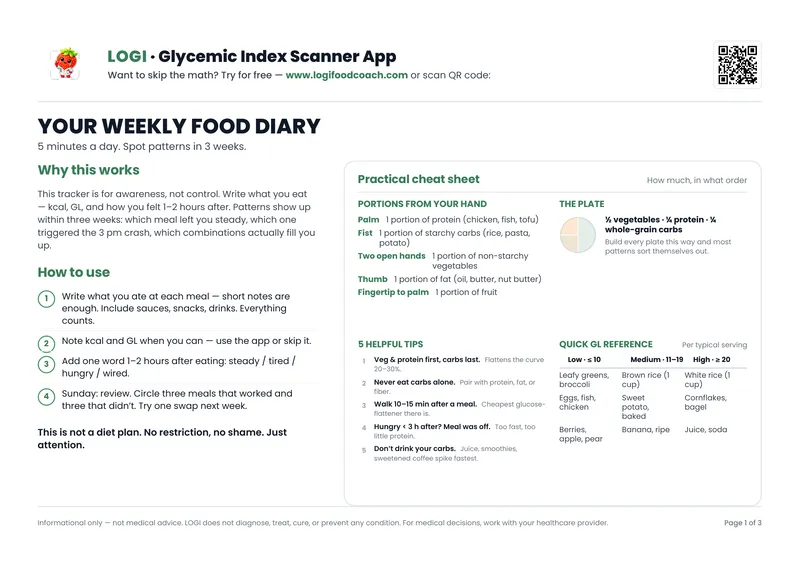
বিনামূল্যে PDF — ৩ পৃষ্ঠা
সাপ্তাহিক খাদ্য জার্নাল
খাবার, গ্লাইসেমিক লোড ও মেজাজ ট্র্যাক করুন। ৩ সপ্তাহে প্যাটার্ন খুঁজুন।
কোনো স্প্যাম নেই। যেকোনো সময় আনসাবস্ক্রাইব।